Direct Seawater Electrolysis Technology for Distributed Hydrogen Production.

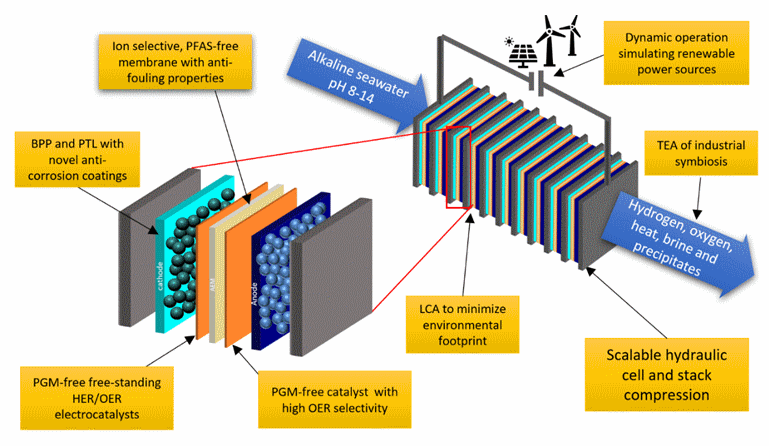
SWEETHY project aims to develop an advanced technology for direct seawater electrolysis capable of producing hydrogen (H₂) and oxygen (O₂) under intermittent conditions, accounting for coupling with renewable energy sources (in particular wind and photovoltaic). The electrolyzer is based on an Anion Exchange Membrane (AEM) operating in natural or alkaline seawater, and the SWEETHY technology is developed along three axes.
a) Materials and components optimization
To meet the specific requirements of the marine environment: the focus is placed on the corrosion resistance and selectivity of precious-metal-free electrocatalysts to catalyze the hydrogen and oxygen evolution reactions. These catalysts are deposited on highly selective AEM membranes for hydroxide anion transport and equipped with anti-fouling properties. In parallel, novel anti-corrosion coatings to protect bipolar plates and porous transport layers are developed and prepared by plasma spraying and electrodeposition.
b) Development of an electrolyzer stack prototype for direct seawater electrolysis
Based on an innovative architecture using hydraulic cell compression, prototype will be designed to integrate the advanced materials and produce hydrogen at high pressure. The key advantages of this technology relate to scalability and operational reliability, which will be significantly improved compared to conventional AEM electrolyzers.
c) Sustainability analysis at system level
Not only of the electrolyzer system itself, but also of its integration into renewable energy systems and the efficient use of by-products in industrial applications, with early feedback into materials optimization and electrolyzer development. Complementing life cycle analysis, qualitative social and techno-economic analyses will ensure the environmental, economic and social sustainability of the new technology.
By combining these three aspects, the technology developed in SWEETHY will be demonstrated using Mediterranean seawater in Messina, Italy. The objective is to withstand more than 2,000 hours of operation and produce 20 gH₂/h with a degradation rate lower than 1%/100h. In addition, SWEETHY will demonstrate how electrolyzer operation can optimize revenues related to by-products and grid services.
The role of the French Corrosion Institute in the SWEETHY project is to carry out ex-situ characterization of the corrosion resistance of materials and coatings used in the electrolyzer. The French Corrosion Institute also develops low-cost anti-corrosion coating solutions for these specific conditions.
Partners of the Sweethy project
The SWEETHY consortium (9 partners) is composed of renowned European R&D institutes and SMEs with solid experience in national and European projects related to water electrolysis, materials for energy applications, and marine technologies. The partners possess complementary expertise covering the entire value chain of water electrolysis.
| RISE Research Institutes of Sweden (Sweden) | Consiglio Nazionale Delle Ricerche (Italy) |
| Fundacion Cidetec (Spain) | DEUTSCHES ZENTRUM FUR LUFT – UND RAUMFAHRT EV (Germany) |
| Institut de la Corrosion (France) | SINTEF (Norway) |
| Propuls (Germany) | CUTTING-EDGE NANOMATERIALS CENMAT (Germany) |
| Uniresearch (Netherlands) |
En savoir plus
Project website : https://sweethy.eu/
Sweethy on LinkedIn : https://www.linkedin.com/company/sweethy/posts/?feedView=all
This project is funded by the European Union in the frame of the research and innovation program Horizon Europe and the Clean Hydrogen Partnership
_____________________________________
Views and opinions expressed are those of the author(s) only and do not necessarily reflect those of the European Union or REA. Neither the European Union nor the granting authority can be held responsible for them.