Corrosion sensors and NDT for continuous monitoring of your infrastructure
Corrosion Sensors and NDT solutions enable continuous, in-situ monitoring of industrial infrastructure. The French Corrosion Institute develops tailor-made sensor solutions to assess material durability, detect degradation risks early, and optimise preventive maintenance programmes. These solutions are deployable across a wide range of environments: atmospheric, immersed, buried or under irradiation.
Corrosion sensors and NDT using electrical resistance (ER): AirCorr range
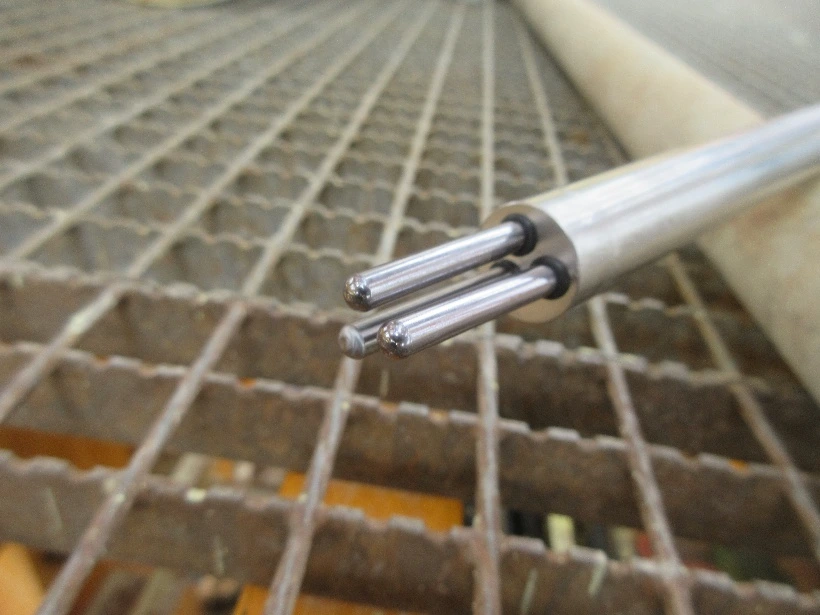
Among commonly used monitoring techniques, electrical resistance (ER) sensors offer a robust and reliable solution for corrosion assessment. Their principle is based on measuring changes over time in the electrical resistance of a metallic element. As corrosion progresses, the cross-sectional area of the element decreases, leading to an increase in the measured electrical resistance. These resistance variations are then converted into metal thickness loss and corrosion rate, enabling real-time evaluation of material degradation.
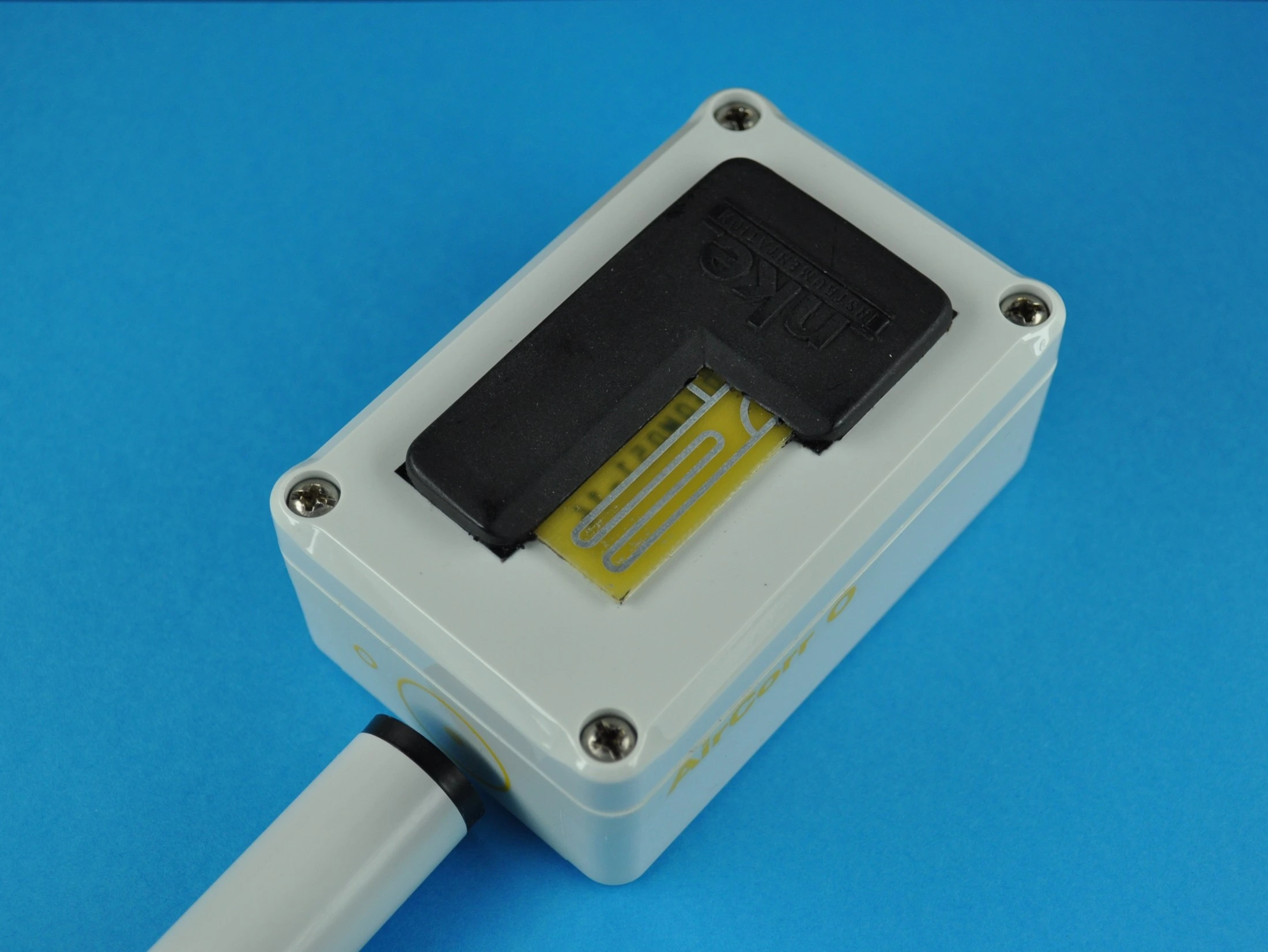
AirCorr O – Standalone sensor and data logger
Compact, watertight and standalone corrosion monitoring system, designed for use in severe outdoor atmospheric conditions. For immersed or buried applications, the sensor can be connected remotely to the logger via a cable of up to 100 metres, offering great installation flexibility in varied field conditions.
AirCorr T – OEM Transmitter (new)
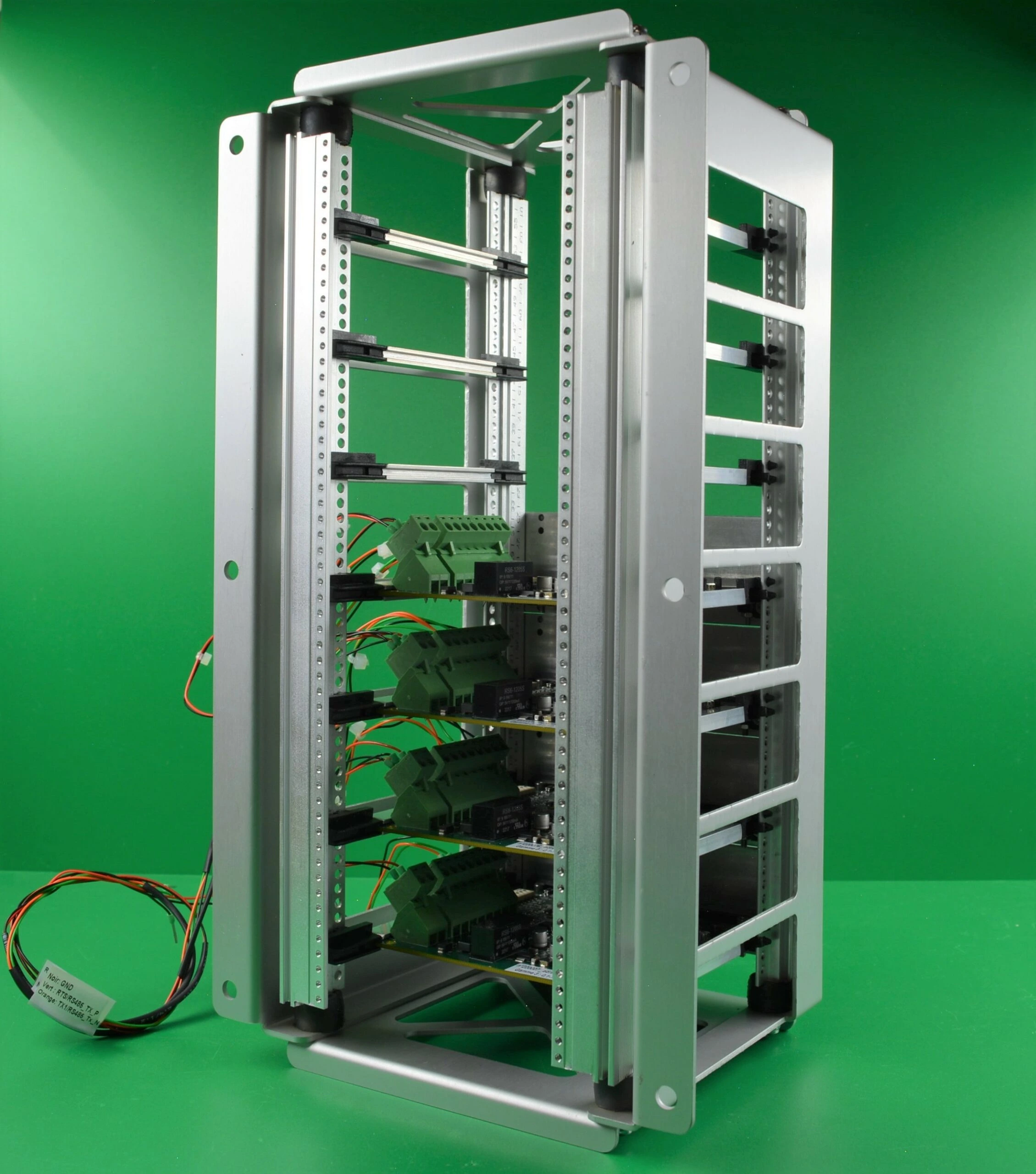
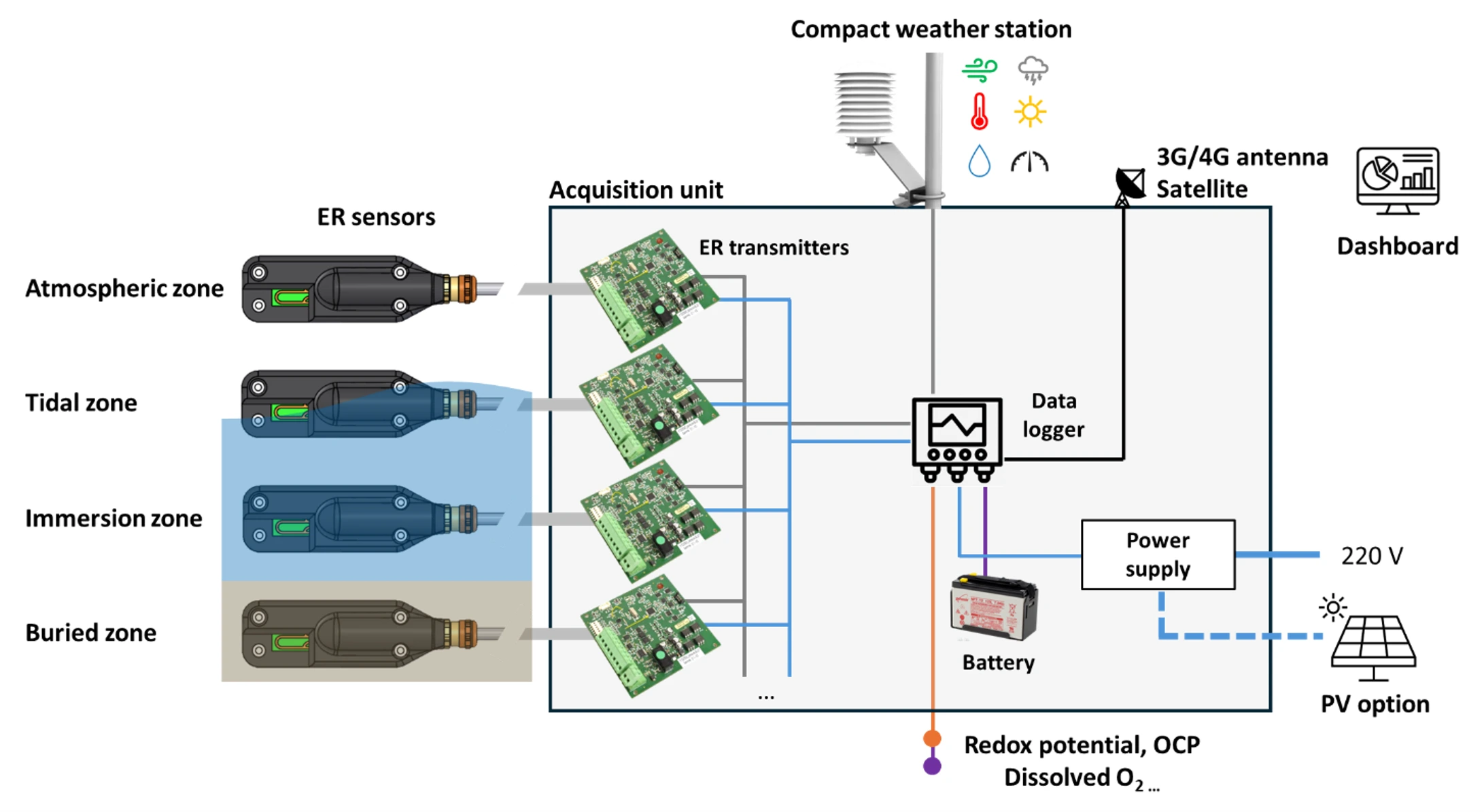
Designed for applications requiring real-time and continuous data transmission. Using the RS-485 communication protocol, the AirCorr T OEM allows multiple transmitters and ER sensors to be connected to a single data logger. Remote access can be set up for real-time data reading and processing via a dedicated dashboard.
Custom thick ER sensors and tailor-made monitoring solutions (new)
Thick ER sensors (1 to 4 mm), manufactured on demand from industrial materials, for atmospheric, immersed and buried environments. Several ER sensors as well as complementary probes for monitoring weather, hydrological or soil conditions can be integrated into a custom acquisition cabinet offering remote data access via a dedicated dashboard.
Corrosion prediction and artificial intelligence (new)
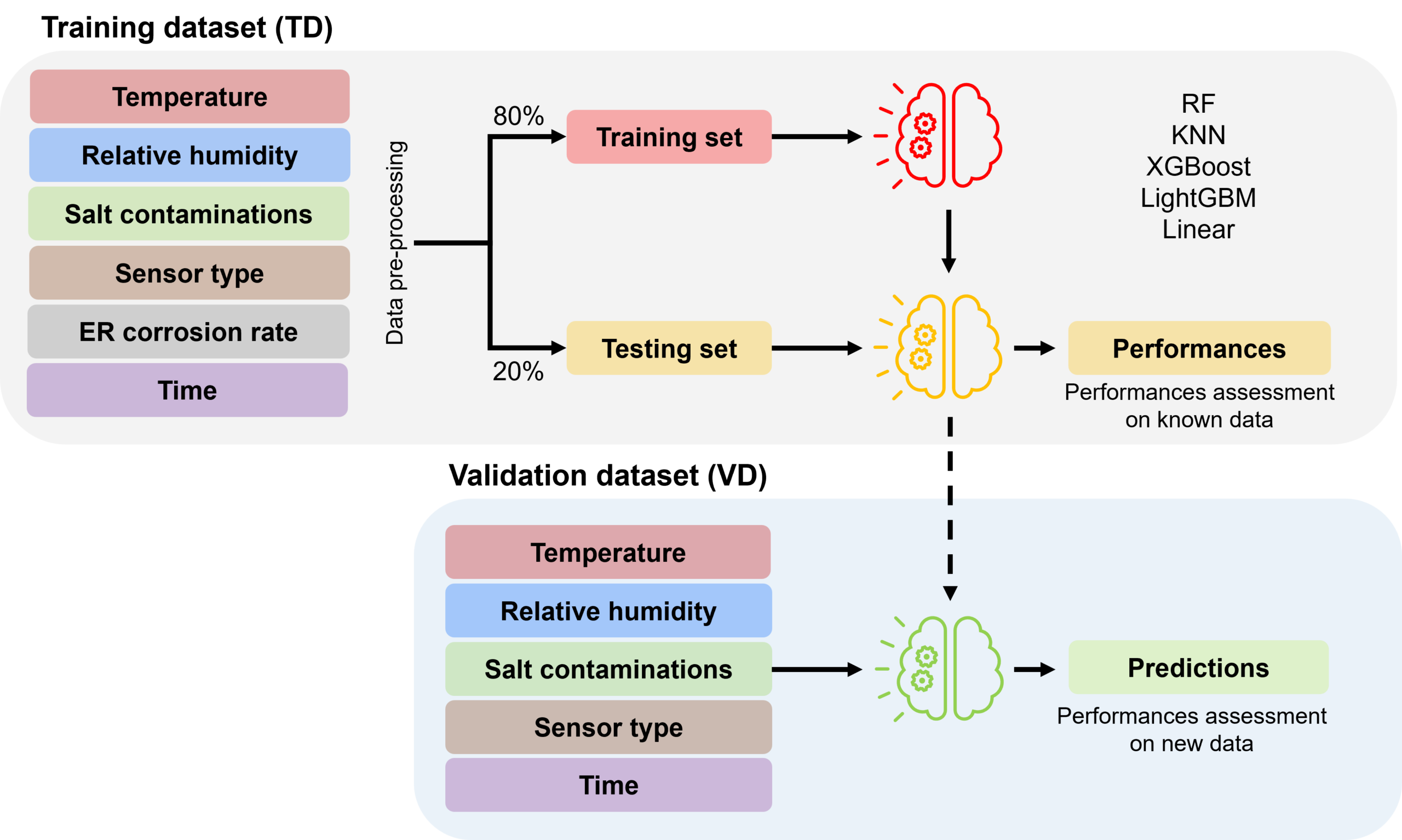
The simultaneous monitoring of corrosion and environmental parameters through the various sensors makes it possible to build up extensive databases, essential for refining the understanding of corrosion mechanisms across different environments. The French Corrosion Institute therefore offers new services based on artificial intelligence tools to model and predict corrosion phenomena.
Application areas
- Offshore infrastructure: corrosion and cathodic protection monitoring of marine structures
- Onshore infrastructure: monitoring of buried pipelines and structures in soil
- Transport sector: atmospheric corrosivity monitoring on vehicles and structures
- Nuclear: monitoring under gamma irradiation for deep geological disposal of radioactive waste
- Chemical and process industry: monitoring the corrosivity of process environments
Our experts are here to support you
Contact us : brest@institut-corrosion.fr / +33 (0)2 98 05 15 52
LPR Probes and Acoustic Emission
In addition to analysing external corrosivity, the French Corrosion Institute offers monitoring of the internal corrosivity of equipment. Degradation tracking uses in-situ corrosion coupons, enabling detailed laboratory analysis of the degradation modes observed.
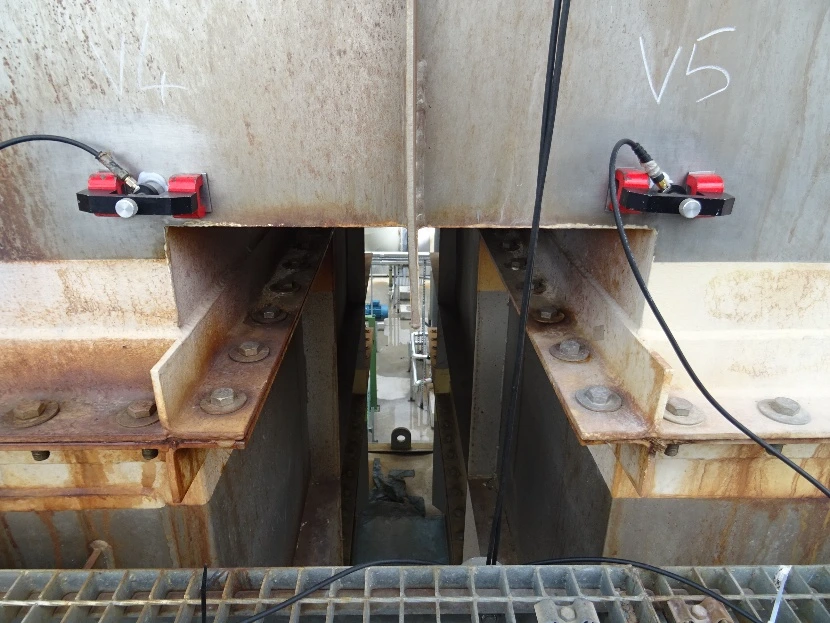
Where the time variability of operating parameters is significant, acoustic emission (AE) provides an effective alternative. An acquisition system supporting up to 8 simultaneous channels detects crack propagation in industrial installations across a temperature range of –65 °C to +175 °C.
The French Corrosion Institute also offers electrochemical monitoring via an LPR probe (max. pressure 100 bars), programmed and interpreted by an expert, for quantitative assessment of internal corrosion rate.
Our experts will provide you with the information you need
Contact us: lyon@institut-corrosion.fr / +33 (0)4 28 27 03 66
F.A.Q – Corrosion sensors and NDT
1. What types of corrosion sensors and NDT solutions does the French Corrosion Institute offer ?
The French Corrosion Institute develops and markets several families of solutions. AirCorr electrical resistance (ER) sensors provide continuous monitoring in atmospheric, immersed or buried environments. LPR probes track the internal corrosivity of equipment. Acoustic emission (AE) systems detect crack propagation by non-destructive testing. AI-based prediction tools complete this offer.
2. In what environments can AirCorr sensors be deployed ?
AirCorr sensors operate across a wide range of environments: severe outdoor atmospheric, immersed, buried soil and gamma irradiation. The AirCorr O model is standalone and watertight. The AirCorr T OEM connects multiple sensors to a centralised logger via RS-485 protocol. A dedicated dashboard provides remote access to data in real time.
3. What is the difference between an ER sensor and an LPR probe ?
An ER sensor measures the cumulative thickness loss of a metallic element. It evaluates corrosion rate without contact with the internal fluid. An LPR probe measures the polarisation resistance of an electrode in direct contact with the corrosive medium. It provides an instantaneous assessment of the internal corrosion rate. Both techniques are complementary depending on the nature of the equipment being monitored. For further information on electrochemical measurement methods, see the ISO 16773 standard (electrochemical impedance spectroscopy).
4. Is it possible to integrate multiple sensors into a centralised monitoring system ?
Yes. The French Corrosion Institute offers custom acquisition cabinets. They integrate multiple ER sensors, meteorological, hydrological or soil probes. A transmission system sends data remotely. A dedicated dashboard enables real-time reading and analysis. This solution adapts to the field constraints of each infrastructure.