Hydrogen embrittlement under cathodic or gaseous conditions
Hydrogen embrittlement (HE) is a critical risk for metallic materials exposed to aqueous or gaseous environments. The French Corrosion Institute provides characterization, qualification and consulting on alloy resistance to this phenomenon, across all industrial sectors.
A critical risk for high-performance alloys
Hydrogen embrittlement (HE) refers to a loss of mechanical properties in metallic materials caused by the presence of hydrogen—whether internal (introduced during manufacturing) or external (coming from the service environment).
General mechanism
Hydrogen, in its atomic form, diffuses into the metal structure and accumulates at microstructural defects (grain boundaries, precipitates, dislocations). This accumulation locally weakens the material and can lead to premature failure or delayed cracking under stress, sometimes without any visible prior warning signs.
Industrial risks:
Failures due to hydrogen embrittlement often occur suddenly in components that appear intact, compromising structural integrity and the safety of installations.
Hydrogen embrittlement phenomena are classified according to the source of hydrogen (internal or external) and the degradation mechanism, enabling a systematic approach to material qualification.
HE
Hydrogen Embrittlement: generic term referring to the loss of mechanical properties caused by hydrogen
EAC
Environmental assisted cracking: interaction between stress and hydrogenating environment
HIC
Hydrogen-Induced Cracking: buildup of localized pressure, typical of H₂S environments
HISC
Hydrogen Induced Stress Cracking: stress corrosion cracking driven by hydrogen, particularly relevant in offshore cathodic protection applications
HAC
Hydrogen-Assisted Cracking: fracture dominated by interactions between hydrogen and the microstructure
SSC
Sulfide Stress Cracking: embrittlement occurring in the presence of H₂S in oilfield fluids
Factors influencing susceptibility to hydrogen embrittlement
Material
Mechanical strength, microstructure, heat treatment, coatings
Mechanical loading
Applied stress, residual stresses, strain level
Environment
Hydrogen pressure, temperature, composition, pH, H₂S, O₂
Diffusion & trapping
Apparent diffusion coefficient, trapping, diffusible hydrogen
Exposure time
Cumulative hydrogen charging, phenomenon of delayed fracture
Surface state
Roughness, passive/oxide layer, sacrifial coating (Zn, ZnNi)
Hydrogen embrittlement in aqueous environments and gaseous hydrogen
The French Corrosion Institute has the testing capabilities and expertise to characterize susceptibility to hydrogen embrittlement across the two main categories of service environments.
Aqueous media
In aqueous environments, hydrogen is produced by cathodic electrochemical reactions at the metal surface – active corrosion, cathodic protection or overprotection, and acidic environments (H₂S, HCl). The absorption rate depends on the electrochemical potential, pH, the composition of the environment, and the presence of absorption promoters.
Seawater + cathodic protection → HISC / EAC
H₂S conditions (Oil&Gas) → SSC / HIC – severe
Atmospheric corrosion (NaCl, MgCl₂) → HE of high strength steels
Acidic conditions (pickling, process) → Internal hydrogen
Electrodeposition (Zn, ZnNi) → Delayed fracture
Gaseous media at high pressure
High-pressure gaseous hydrogen interacts with the metal surface through adsorption, dissociation, and subsequent absorption. Hydrogen fugacity, which increases with pressure, is the key parameter governing severity. Certain contaminants (O₂, CO) act as inhibitors, while others (H₂S, moisture) enhance hydrogen uptake.
Typical pressure range (H₂ mobility) → 20 – 700 bar
Effect of O₂ (contaminant) → Inhibitor (reduce the sensitivity)
Effect of H₂S (contaminant) → Promotor (increase absorption)
Autoclave testing (up to 250 kN) → SSRT, Fracture Toughness, Fatigue
Hollow specimens → Alternative for low/high temperature testing
Mechanisms of hydrogen entry into metals
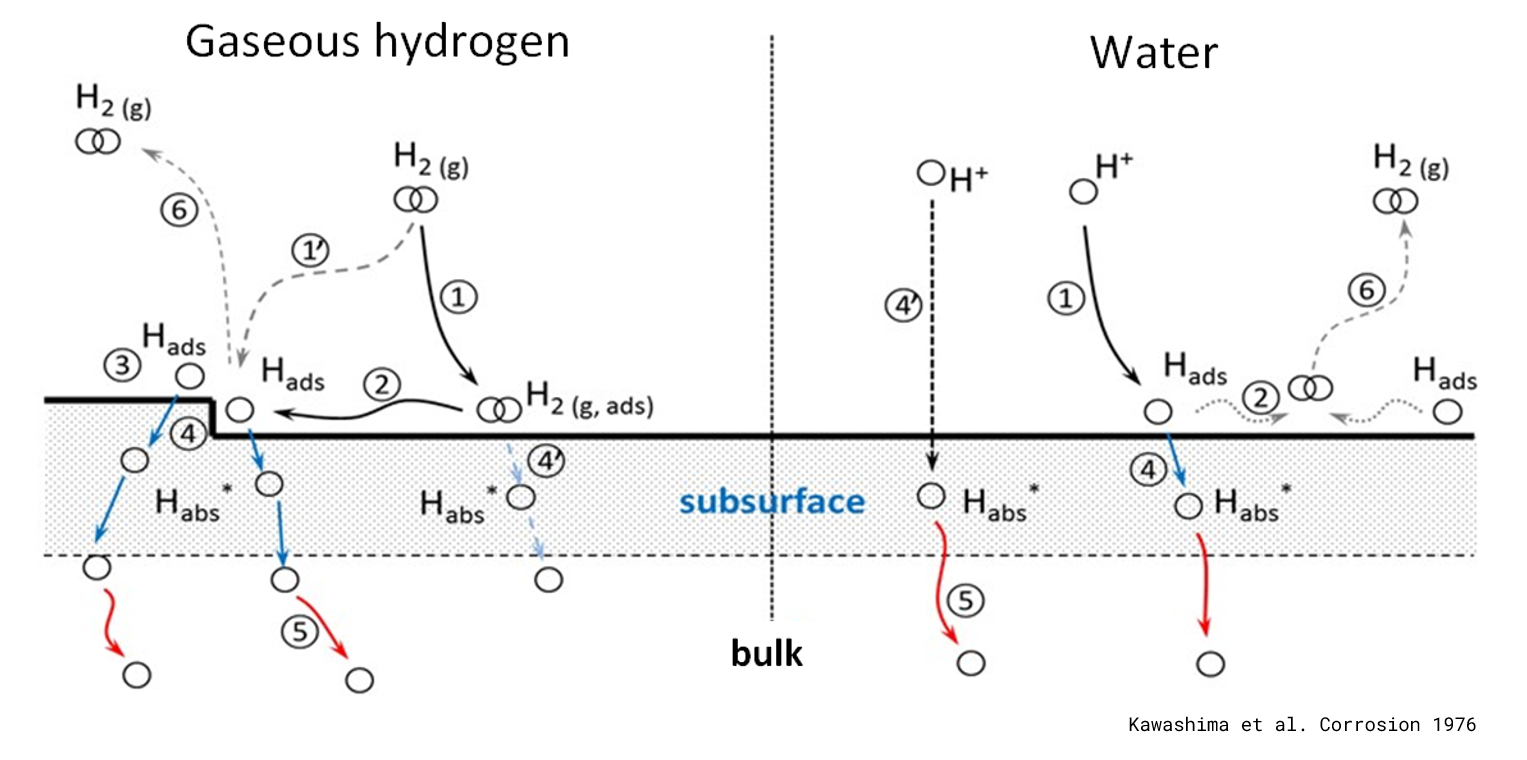
Main hydrogen evolution reactions at the surface of a metal from aqueous and gaseous environments:
- Adsorption (direct adsorption-dissociation),
- Surface migration,
- Dissociation,
- Sub-surface absorption (direct absorption),
- Diffusion into the bulk and trapping,
- Molecular recombination.
Expertise by sector
The French Corrosion Institute supports all industrial sectors facing hydrogen embrittlement risks, from material qualification to in-service failure analysis.
Automotive
The manufacturing of chassis components, suspension systems, and structural parts made from very high-strength steels (> 1,200 MPa) exposes them to hydrogen embrittlement during forming, heat treatment, coating processes, or in service through atmospheric corrosion.
- High-strength bolts and fasteners (ASTM F519)
- Stamped and cut structural parts – sharp sheared edges
- Effects of zinc/ZnNi coatings – galvanic hydrogen embrittlement under humid atmospheric conditions
- Qualification with respect to accelerated corrosion tests (NVDA, ACT1, etc.)
- Development of UHSS grades (> 1500 MPa)
- Quantification of diffusible hydrogen and trapping mechanisms
Aerospace and defense
Alloys used in aerospace – high-strength stainless steels, titanium alloys, 7000 series aluminum alloys, and nickel-based alloys – exhibit specific sensitivities to hydrogen embrittlement during manufacturing and in humid service conditions.
- Landing gear and structural components made of high-strength steels
- 7xxx series aluminum alloys – hydrogen embrittlement under humidity or atmospheric corrosion
- Titanium alloys – risk of embrittling hydride formation
- Bolting and fastening systems – e.g. ISO 15330
- Failure analysis: fracture surfaces, microstructure
- Analysis of internal/diffusible hydrogen
Learn more about our expertise in the aerospace sector.
Offshore infrastructures
In seawater, cathodic protection applied to steel structures generates high hydrogen activity at the surface. Subsea connections, seabed bolting, and high-strength alloys used for tubing and fittings are particularly exposed to the risk of HISC (Hydrogen-Induced Stress Cracking).
- HISC in stainless steels and nickel-based alloys (DNVGL-RP-F112)
- Offshore bolting – qualification according to ISO 15156 / NACE MR0175
- Nickel-based alloys – determination of KIH in seawater
- Effects of cathodic overprotection – representative testing conditions
- Qualification of new materials for subsea applications
Learn more about our expertise in the offshore sector.
Oil, Gas & Petrochemicals
Present in crude oil and natural gas, H₂S is one of the most embrittling environments. SSC (Sulfide Stress Cracking) and HIC (Hydrogen-Induced Cracking) are major concerns for the selection of materials used in tubing, casing, and surface equipment.
- NACE TM0177 testing (Methods A, B, C, D) in H₂S solution
- HIC testing according to NACE TM0284 – pipeline steels
- Qualification in accordance with ISO 15156 / NACE MR0175 for materials exposed to H₂S
- Pipeline steels X65–X100 – stress corrosion cracking and fatigue
- High-pressure/high-temperature (HPHT) conditions – downhole environments
Learn more about our expertise in the Oil & Gas sector
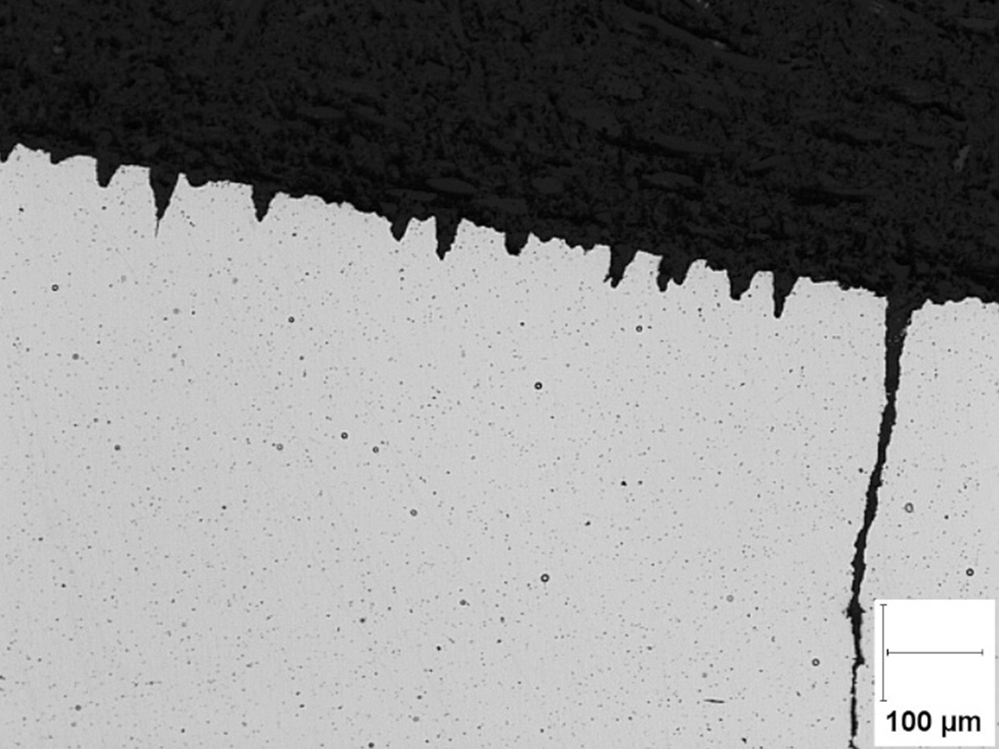
High-pressure H₂ transport & storage
The development of the hydrogen sector (refueling stations, dedicated pipelines, onboard storage tanks) requires rigorous qualification of metallic materials in contact with high-pressure gaseous hydrogen, from 20 to 700 bar.
- High-pressure H₂ autoclave testing (SSRT, ISL, fatigue, fracture toughness), up to 250 kN and 700 bar
- Hollow specimens : a cost-effective alternative for material pre-selection or low-temperature conditions
- Pipeline steels (e.g. X65), 316L stainless steels, and others
- Effect of contaminants: O₂, CO, H₂S, moisture on hydrogen fugacity
- Standardized framework: ISO 11114, ASME B31.12, SAE J2579, EN 17533
Learn more about our gaseous hydrogen testing capabilities
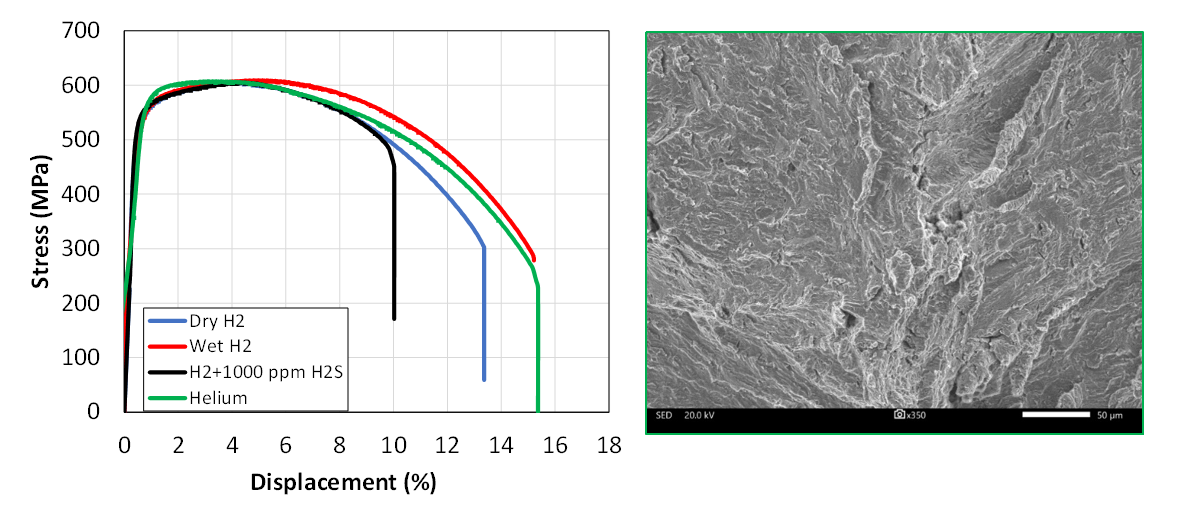
Hydrogen embrittlement characterization methods
The French Corrosion Institute’s laboratories are equipped with a comprehensive technical platform for assessing susceptibility to hydrogen embrittlement, tailored to different materials, environments, and industry-specific regulations.
| Test method | Results obtained | Typical duration | Environment |
|---|---|---|---|
| Constant load | Pass/fail; stress and time to fracture; KIH | 720 h to 3,000 h | Aqueous Gaseous |
| Constant displacement (C-ring, 3PB, U-bend) | Pass/fail; stress and time to fracture | A few hours to >100 h | Aqueous |
| Slow strain rate (SSRT) | Embrittlement indices | 2 to 15 days | Aqueous Gaseous |
| Incremental step loading (ISL / VDA 238-201) | Critical stress threshold; KIH | Variable (step-wise) | Aqueous Gaseous |
| Fracture mechanics (CT, SENB) | Critical KIH; da/dt = f(KI) | 100 to 10,000 h | Aqueous Gaseous |
| Environmental fatigue | S-N curves; da/dN = f(ΔK) | Variable (frequency) | Aqueous Gaseous |
| Electrochemical / gaseous permeation | Diffusion coefficient; hydrogen flux | A few days | Aqueous Gaseous |
| Thermal desorption spectroscopy (TDS) | Quantification of diffusible/total H; trapping energies | Rapid analysis | Mat. analysis |
Main applied standards
Range of materials studied
The French Corrosion Institute’s expertise covers all families of metallic alloys used across the aforementioned industrial sectors, with particular emphasis on the correlation between microstructure and susceptibility to hydrogen embrittlement.
Steels and stainless steels
High-strength ferritic and martensitic steels (Rm > 900 MPa) exhibit increasing susceptibility with hardness level. For austenitic steels, the stability of the austenitic phase, linked to nickel content, is the key parameter. Duplex and superduplex stainless steels are evaluated using specific protocols that take into account their biphasic microstructure.
- Pipeline steels X52 to X100 and HSLA steels
- Bolting steels (grades 8.8 to 14.9)
- Stainless steels 316L, duplex 2205, superduplex 2507
- Maraging and precipitation-hardened steels
Special alloys
Nickel-based alloys (718, 725, 925) are widely used in offshore and petrochemical applications. Their qualification under cathodic protection or in H₂S environments requires long-duration testing on pre-cracked specimens. 7000 series aluminum alloys exhibit specific sensitivity under humid and high-temperature conditions. Titanium alloys are assessed for the risk of hydride-induced embrittlement.
- Nickel-based alloys: 718, 725, 925, 625, C-276, etc.
- Aluminum alloys 7075, 7150, 7050 (7xxx series)
- Titanium alloys Ti-6Al-4V and β alloys
Our expertise in hydrogen embrittlement
The French Corrosion Institute supports industrial companies and engineering firms throughout all stages of material qualification with respect to hydrogen embrittlement: selection of testing methods tailored to your application, laboratory testing, interpretation of results, and preparation of reports compliant with applicable standards and regulations. Our team also provides in-house training and knowledge transfer on both the theoretical and practical aspects of hydrogen embrittlement.
F.A.Q – Hydrogen embrittlement
1. What is the difference between HE, HIC and SSC ?
These three phenomena refer to distinct hydrogen-related degradation modes. Hydrogen Embrittlement (HE) is the generic term: loss of ductility caused by internal or external hydrogen. HIC (Hydrogen-Induced Cracking) refers to cracking driven by localized pressure build-up, typical of H₂S environments in pipeline steels. SSC (Sulfide Stress Cracking) combines applied stress with H₂S exposure, and primarily affects high-strength steels and alloys in the oil and gas industry. Learn more about our H₂S testing capabilities.
2. Which materials are most susceptible to hydrogen embrittlement ?
Susceptibility generally increases with mechanical strength. Among the most exposed: martensitic steels above 900 MPa, grade 10.9 and 12.9 bolting, nickel-based alloys under offshore cathodic protection (HISC), and 7xxx aluminium alloys in humid conditions. Austenitic steels and titanium alloys exhibit specific sensitivities related to their microstructure.
3. What tests do you carry out to qualify a material against HE ?
The French Corrosion Institute offers a comprehensive panel: constant load and constant displacement tests, slow strain rate testing (SSRT), incremental step loading (ISL/VDA 238-201), fracture mechanics (CT, SENB), environmental fatigue, electrochemical/gaseous permeation, and thermal desorption (TDS). All are carried out in aqueous environments and under high-pressure gaseous hydrogen up to 700 bar, in accordance with NACE, ISO, ASTM and VDA standards.
4. Does hydrogen embrittlement concern hydrogen energy applications ?
Yes, it is a central issue for the hydrogen sector. Pipelines, onboard tanks, refueling stations and electrolysers must be qualified under gaseous hydrogen pressure according to specific standards (ASME B31.12, SAE J2579, EN 17533, ISO 11114). To meet these requirements, the French Corrosion Institute operates autoclave facilities capable of testing up to 700 bar and 250 kN. Discover our hydrogen laboratory.