Cathodic protection : design, sizing and modelling of your systems
Cathodic protection design and sizing for immersed and buried structures is one of the French Corrosion Institute’s core areas of expertise. The distribution of galvanic anodes or the impressed current protection system is optimised through calculation and modelling.
Cathodic protection system design
The French Corrosion Institute supports its customers in the design, sizing and verification of cathodic protection systems for a wide range of metallic structures: pipelines, buried pipelines, offshore structures, harbour facilities, tanks and civil engineering infrastructure.
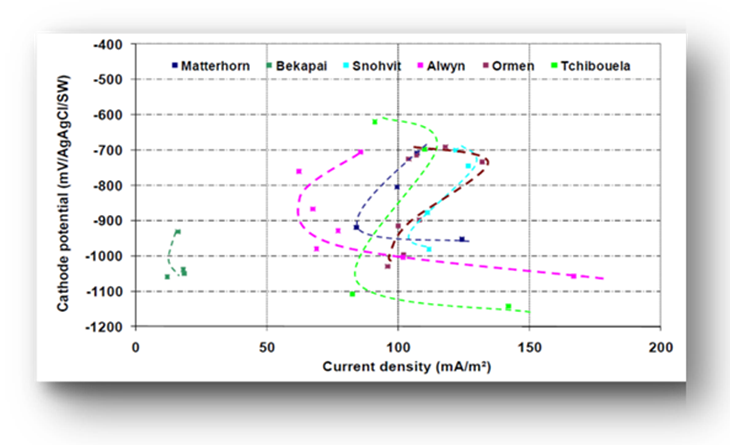
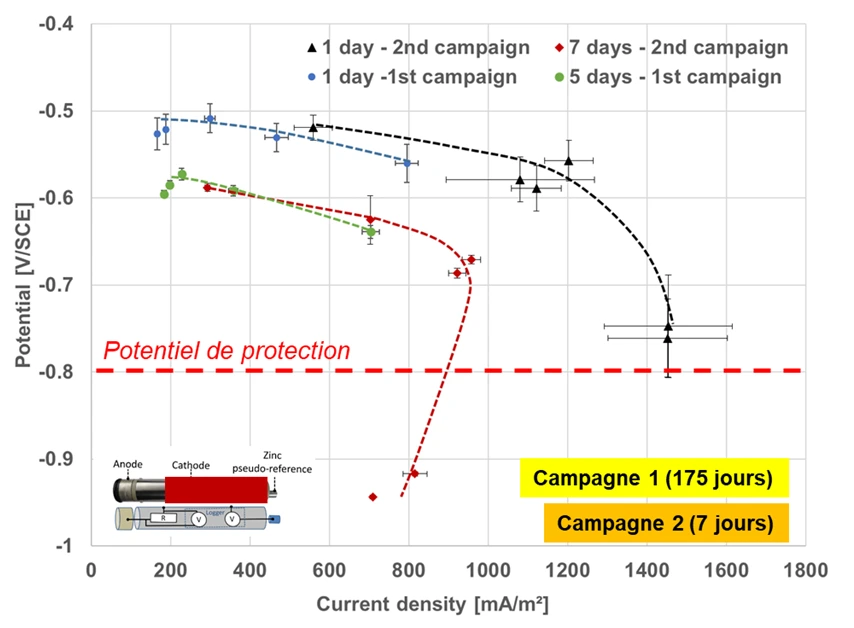
Our engineers carry out sizing studies for both impressed current (ICCP) and galvanic (sacrificial) anode systems, taking into account key parameters such as electrolyte resistivity, surfaces to be protected, required protection current densities and target service lifetimes. These studies are based on applicable standards (EN ISO 15589, EN 13173, NACE SP0169, etc.), on the experience of our teams and on our extensive internal database of polarisation curves obtained under real operating conditions.
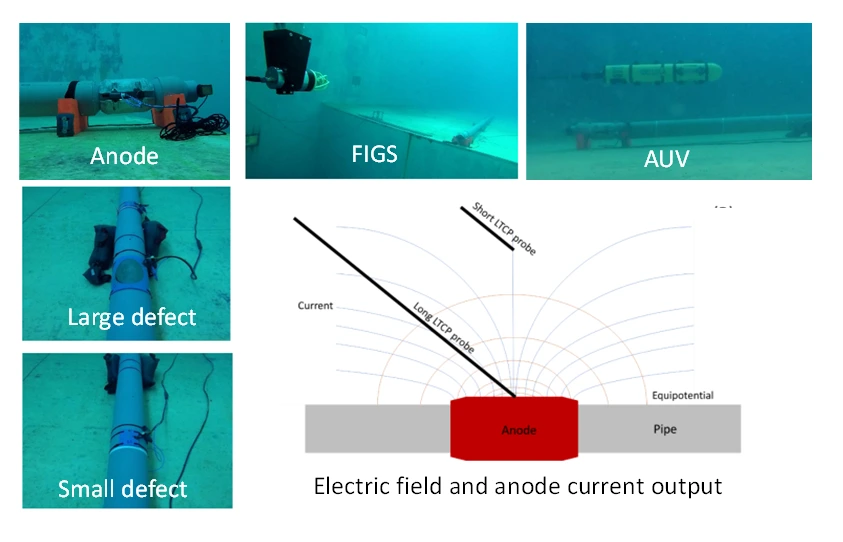
We also carry out site interventions to validate operational constraints and to implement long-term monitoring of its effectiveness.
Cathodic protection modelling
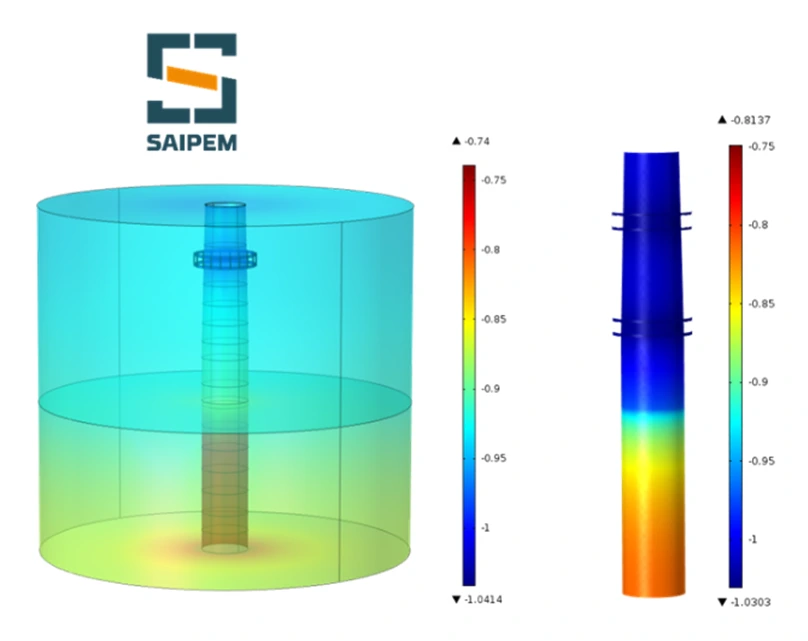
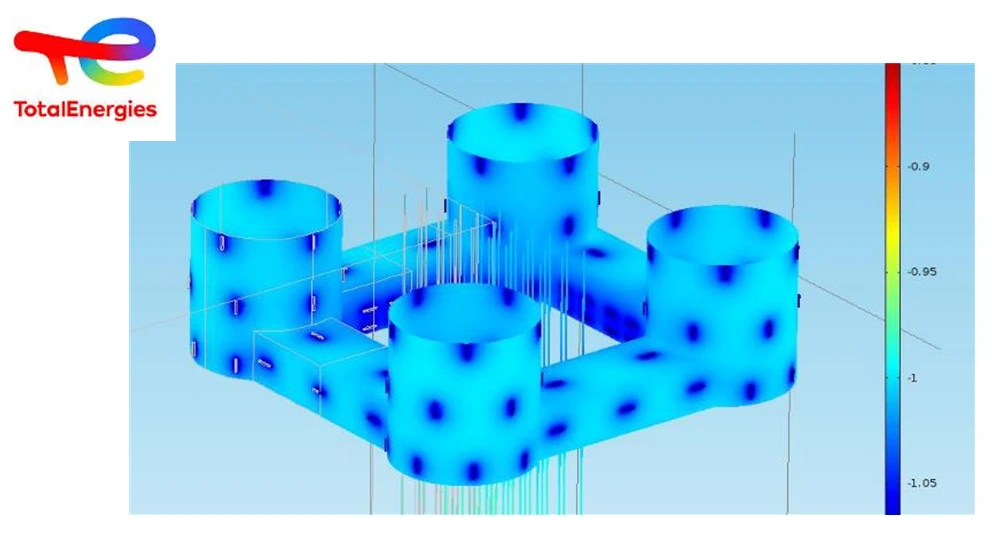
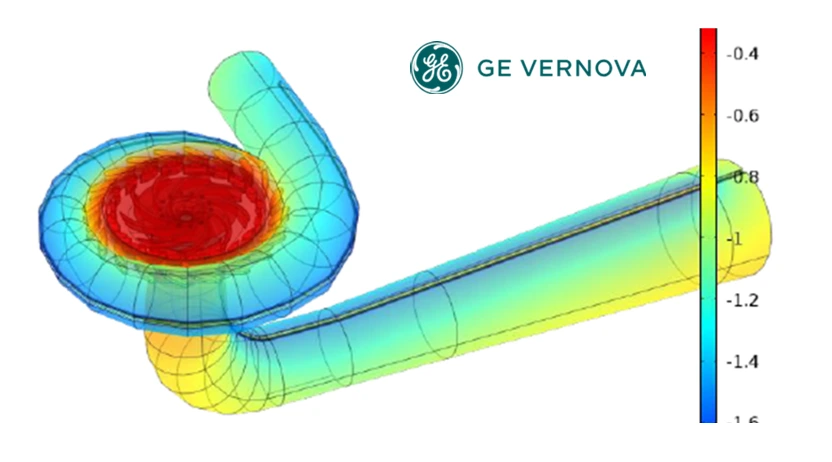
The French Corrosion Institute has recognised expertise in the numerical modelling of cathodic protection, using finite element (FEM) and boundary element / boundary integral (BEM) approaches, in particular with COMSOL Multiphysics software.
These simulation tools allow the modelling of potential distribution and current densities in the electrolyte, incorporating the electrochemical boundary conditions (polarisation curves) specific to the materials and environments under study. We model complex 2D and 3D geometries, whether for offshore or onshore structures.
Modelling offers several concrete benefits:
- Optimisation of anode placement and number of current sources prior to installation
- Prediction of protection distribution across the entire structure, including shielded areas
- Assessment of interference between neighbouring systems (stray currents, galvanic coupling)
- Reduction of design costs by limiting the need for physical testing
Our modelling studies can be combined with field measurements for model validation and simulation updates under real operating conditions.
Experts at your service
The EN ISO 15257:2017 standard is the European reference for the certification of competencies in this field. It defines five qualification levels, ranging from technician to expert, and applies to four main fields: onshore and buried structures, marine structures, reinforced concrete, and internal surfaces.
This standard forms the basis of national certification schemes, such as those operated by CEFRACOR (CFPC) in France, and is aligned with the general framework for personnel certification in accordance with ISO/IEC 17024, ensuring international recognition, reliability, and harmonisation of competencies.
Nicolas Larché
Level 5 Expert in cathodic protection of marine structures
Charles Leballeur
Level 4 Senior Engineer in cathodic protection of marine structures
Erwan Diler
Level 3 Specialist in cathodic protection of onshore and buried structures
Julien Pellé
Level 3 Specialist in cathodic protection of marine structures
Pascal Moullec
Level 1 Technician in cathodic protection of marine structures
Contact us : brest@institut-corrosion.fr
F.A.Q
1. What structures can benefit from cathodic protection ?
Cathodic protection applies to any metallic structure in contact with an electrolyte: buried pipelines, offshore structures, wind turbine foundations, harbour facilities, tanks, and civil engineering infrastructure made of steel.
2. What is the difference between galvanic anode and impressed current (ICCP) systems ?
Galvanic anodes (zinc, aluminium, magnesium) sacrifice themselves spontaneously to protect the structure without any external power source. An ICCP system uses an external current source to force cathodic polarisation. The choice depends on structure size, electrolyte resistivity, and target service life.
3. What standards govern the sizing and design of CP systems ?
The main references are EN ISO 15589 (transport pipelines), EN 13173 (offshore structures), NACE SP0169 (buried pipelines), and EN 12954 (buried metallic structures). The French Corrosion Institute applies these standards in combination with its internal database of polarisation curves.
4. What does numerical modelling add over analytical sizing ?
FEM or BEM modelling allows visualisation of the potential distribution across the entire structure, including shielded areas inaccessible to analytical calculation. It optimises anode placement before installation and reduces costs by limiting the need for physical testing.
5. Do you offer long-term monitoring system effectiveness over time ?
Yes. Our teams carry out site interventions to validate operational constraints and monitor long-term effectiveness: potential measurements, current output monitoring, and model updates under real operating conditions.