Modelling of hydrogen activity from atmospheric corrosion in ultra-high strength steels for light structure application.
Steel remains the material of choice in the automotive industry, driven by the continuous development of high-performance grades with outstanding mechanical properties. However, a major challenge still facing the steel industry is demonstrating that its newest steel solutions can withstand the service conditions of a vehicle, particularly those related to hydrogen-assisted cracking under atmospheric corrosion conditions. Ultra-high strength steels are well known to be sensitive to hydrogen embrittlement, and fabrication processes are already adapted from early stages to control the risk of delayed fracture. Steel microstructures are also tailored to reduce hydrogen sensitivity. However, atmospheric corrosion represents an additional source of hydrogen during service life — one that was not critical for lower-strength grades, but becomes a serious concern for steels with ultimate tensile strength above 1,000 MPa. Addressing this challenge is essential to enhance the competitiveness and reliability of high-strength steel solutions.
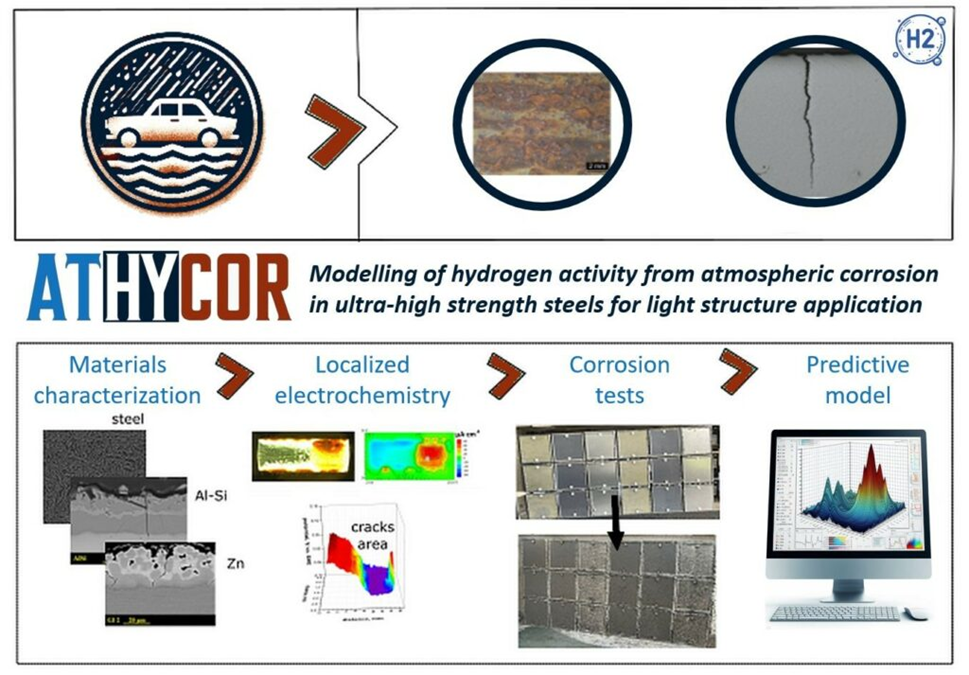
The main scientific objective of the AtHyCor project is to develop a simulation tool capable of modelling hydrogen entry and distribution into coated press-hardened steels (PHS) exposed to atmospheric corrosion conditions. The industrial objective is to provide steelmakers and automotive manufacturers with new data on environmentally assisted fracture risks (hydrogen embrittlement) of ultra-high strength steels, together with a predictive simulation tool. These overarching objectives are structured around three main axes:
I. New data on atmospheric corrosion and hydrogen entry in press-hardened steels
characterization of corrosion mechanisms under simulated atmospheric conditions, quantification of localized corrosion processes using advanced electrochemical and analytical techniques, investigation of the evolution of the water layer and corrosion products, and comparison between accelerated corrosion tests and real outdoor exposures.

II. New methodology to evaluate local hydrogen content from atmospheric corrosion
quantification of hydrogen entry due to atmospheric corrosion, identification of the key governing factors, development of multi-physics models linking surface phenomena (corrosion activity and hydrogen entry) with bulk phenomena (stress/strain distribution and hydrogen trapping), and extension to complex samples and structures.
III. Prediction of hydrogen-assisted cracking risks under atmospheric corrosion conditions
assessment of cracking risks for selected coated high-strength steels, application of the model to standard automotive test conditions, development of practical guidelines for predicting hydrogen-assisted failure, and dissemination of the simulation tool to European research teams.
The AtHyCor project addresses several key limitations in the use of ultra-high strength steels in the automotive industry. The knowledge, datasets and models generated will represent a significant advance beyond the current state of the art in atmospheric corrosion, hydrogen entry and hydrogen-assisted cracking of advanced high-strength steels. The innovative approach lies in the integrated coupling of all these aspects, which is of high relevance and practical value for the steel industry.

Partners of the AtHyCor project
| Institut de la Corrosion (France) | RISE Research Institutes of Sweden (Sweden) |
| IST Instituto Superior Tecnico (Portugal) | UT Prague (Czech Republic) |
| ArcelorMittal Mainières Research (France) | Voestalpine Stahl (Austria) |
Results and papers
Comprehensive overview and main results of the project
- Article: Kinetics of electrochemical reactions on press hardened steel under simulated atmospheric corrosion conditions using local techniques https://doi.org/10.1016/j.electacta.2023.142500
- Article: Scanning Kelvin Probe for Detection in Steel of Locations Enriched by Hydrogen and Prone to Cracking https://doi.org/10.3390/cmd4010010
- Article: Quantification of Hydrogen Flux from Atmospheric Corrosion of Steel Using the Scanning Kelvin Probe Technique https://doi.org/10.3390/met13081427
- Article: Respirometry, a new approach for investigation of the relationship between corrosion-induced hydrogen evolution and its entry into metallic materials https://doi.org/10.1016/j.ijhydene.2024.04.045
- Article: The effect of acidification on hydrogen uptake and corrosion resistance of advanced high-strength steels https://doi.org/10.1016/j.jmrt.2024.10.071
- Article: Corrosion mechanism of press-hardened steel with zinc coating in controlled atmospheric conditions: A laboratory investigation https://doi.org/10.1016/j.corsci.2024.112477
- Article: Corrosion Mechanism of Press-Hardened Steel with Aluminum-Silicon Coating in Controlled Atmospheric Conditions https://doi.org/10.3390/met15010097


This project is co-funded by the European Union in the frame of the RFCS (Research Fund for Coal and Steel) program
_____________________________________
The views and opinions expressed are those of the author(s) only and do not necessarily reflect those of the European Union or the RFCS. Neither the European Union nor the granting authority can be held responsible for them.