Renewable Advanced high strength steels for Vehicle Efficiency and Sustainability.
The RAVES project focuses on thoroughly characterizing the impact of residual elements and contaminants originating from recycling streams on the metallurgical behavior, formability properties, and in‑service performance of Advanced High-Strength Steels (AHSS).
The project seeks a breakthrough in automotive steel circularity by developing a strategy to produce AHSS from end-of life vehicles. Objectives include defining residuals in future steels, understanding contaminant impacts on AHSS microstructures, investigating optimal microstructures, orienting future scrap sorting, and quantifying the impact on energy consumption, CO2 emissions, and natural resources of developed secondary AHSS. The proposed strategy holds the potential for significant environmental benefits, reducing both CO2 emissions and natural resource consumption. The RAVES project represents a key initiative in the European Green Deal which aligns with EU directives (Fit for 55, Zero Pollution Action Plan, Sustainable Development Goals), demonstrating ways to reduce greenhouse gas emissions in the automotive industry.
As project coordinator of RAVES, the French Corrosion Institute is responsible for ensuring the smooth running of the project and for organizing the dissemination of results to the scientific community and to industry. On the technical side, the French Corrosion Institute is in charge of evaluating the corrosion durability and hydrogen embrittlement resistance of the recycled advanced high strength steels and welded assemblies produced by the RAVES project partners.
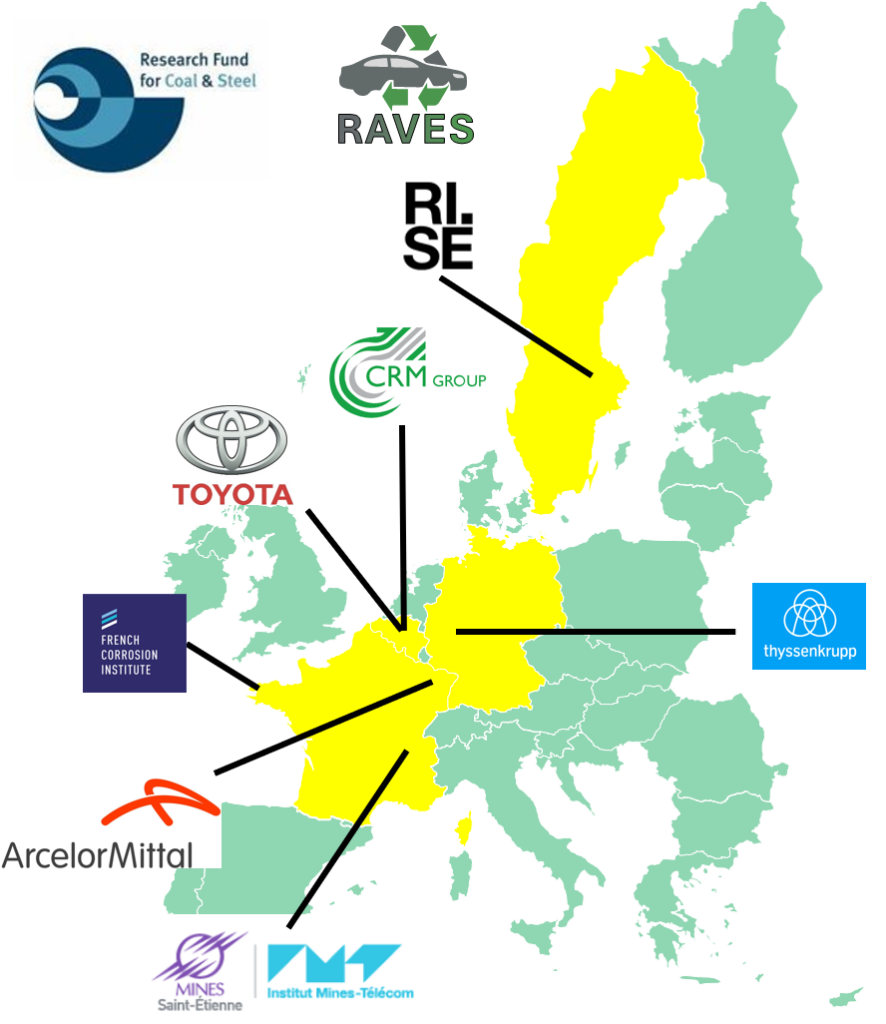
Participants of the project RAVES
The consortium is composed of three industrial partners, ArcelorMittal Maizières Research, Thyssenkruppp and Toyota Motor Europe, one metal research center, Centre de Recherche Métallurgique, two applied research centers, French Corrosion Institute and RISE Research Institutes of Sweden, and one academic partner, Institut Mines-Telecom / CNRS. Such a group will allow to combine large test capacities and infrastructure to advanced characterization methods, with a relevant industrial focus. Thanks to an overlap of skills and competences, critical review of the methodology and results of the project will be possible within this consortium.

| The FRENCH CORROSION INSTITUTE (France) is a leading center for corrosion, fatigue, and hydrogen embrittlement research. With advanced testing facilities, it evaluates materials and structures durability. As project coordinator, FCI manages the project and disseminates results. | RISE RESEARCH INSTITUTES OF SWEDEN (Sweden) is Sweden’s national research and innovation institute, with advanced surface analysis and corrosion testing capabilities. For this project, RISE will conduct mobile corrosion exposure tests and perform advanced surface reactivity analyses, including AP‑XPS. |
| INSTITUT MINES-TELECOM (France) ia the LGF laboratory, is recognized for its expertise in materials, processing, and microstructure modeling. Its work focuses in particular on recrystallization, precipitation, and steel deformation. In this project, it will contribute to microstructural modeling and advanced characterization (SEM‑EBSD, TEM). | CNRS (France), co‑supervisor of the LGF laboratory, provides its expertise in metallurgy and the characterization of high‑performance steels. |
| CRM – CENTRE DE RECHERCHES METALLURGIQUES (Belgium) s a collective research center dedicated to the metals industry. It has strong expertise in steelmaking, new processes, circular economy approaches, and coating development. In this project, CRM will study the impact of process–alloy parameters and will produce the materials using its MPC casting center. | ADVANCED COATINGS & CONSTRUCTION SOLUTIONS (Belgium) a subsidiary of CRM, provides technical support for producing high‑performance steel castings. |
| ARCELORMITTAL MAIZIERES RESEARCH (France) is ArcelorMittal’s main R&D center for flat steels. Its expertise includes metallurgical modeling, new product development, and advanced characterization. In this project, AMMR will participate in material selection, preparation, mechanical and microstructural analysis, as well as the evaluation of in‑use properties. | THYSSENKRUPP STEEL EUROPE (Germany) is one of Europe’s major steel producers, with extensive pilot‑scale capabilities for melting, rolling, and heat treatment. It also possesses advanced characterization tools. As a key supplier of automotive steels, TKS will use the project results to develop new high‑performance steel grades. |
| TOYOTA MOTOR EUROPE (Belgium) oversees R&D, engineering, and manufacturing activities for Europe. Its Materials Engineering division develops innovative and sustainable material solutions for the automotive industry. In this project, TME will evaluate the electroplating compatibility, formability, and weldability of the developed materials. |

Structure of the project
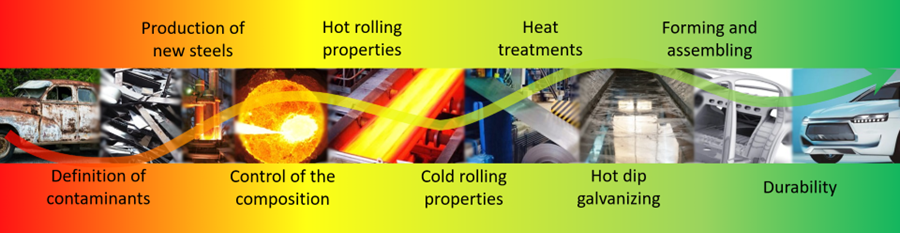
RAVES covers the whole automotive steel value chain, starting by establishing the critical types and quantities of residual elements desired for steel production, reflecting the current and anticipated scrap contamination. This is followed by the production of AHSS incorporating these specific levels of contaminants (WP2). Then, hot rolling properties (WP3), cold rolling behavior, phase transformation during heat treatment (WP4) and compatibility with hot dip galvanizing process (WP6) will be explored. The secondary steels will be finally tested according to automotive requirements (WP5), including formability, assembling and durability aspects (WP7). Finally, Life Cycle Analysis of the developed steels will be evaluated (WP8).
Results and publications
To be completed

This project is co-funded by the European Union in the frame of the RFCS (Research Fund for Coal and Steel) program
_____________________________________
The views and opinions expressed are those of the author(s) only and do not necessarily reflect those of the European Union or the RFCS. Neither the European Union nor the granting authority can be held responsible for them.