
Context
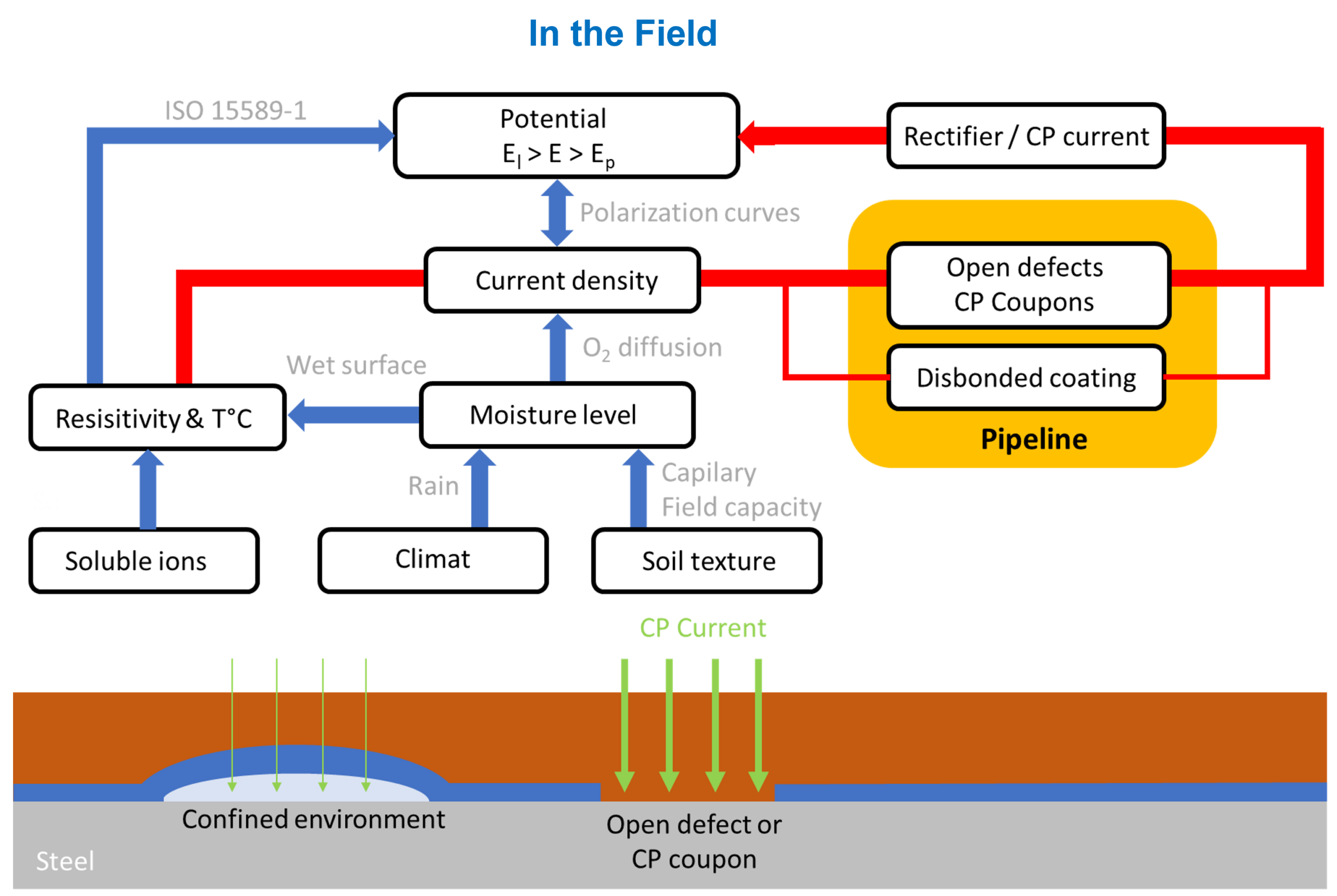
The protection of buried pipelines relies on the complementarity between organic coating and cathodic protection (CP). When a coating disbonds, a confined zone can form between the metal and the coating, trapping an electrolyte. The central question is then whether the cathodic current can cross the disbonded coating in sufficient quantity to protect the underlying steel, or whether the coating shields against CP — a phenomenon known as “shielding”. This debate remains lively within the coating specialist community, with some arguing that fusion bonded epoxy (FBE) coatings, owing to the development of microcracks with ageing, do not block cathodic currents. Yet few studies have experimentally quantified this phenomenon for different coating types, different thicknesses, and taking into account real soil conditions.
Facilities
The study covered seven coating systems supplied by BS Coatings: single- and double-layer FBE (350 to 1,000 µm), liquid epoxy (500 and 1,000 µm) and liquid polyurethane (1,500 µm), prepared both on an S235 steel substrate and as free-standing membranes. A 30-year-old FBE sample, taken from a pipeline in service near a coating defect, was also studied. Electrochemical characterisation relied on electrochemical impedance spectroscopy (EIS), monitored over 12 months of immersion in 3.5% NaCl solution. An H-cell device (Hirtoff cell) was specially designed to reproduce disbondment conditions with or without an open defect in parallel, enabling measurement of the cathodic currents passing through the coating membranes under different oxygen contents.
Key results
The study shows that all the new coatings tested (FBE, liquid epoxy, polyurethane) exhibit very high electrical resistance, making the passage of a significant cathodic current through the coating practically impossible, whatever the applied voltage. These coatings therefore intrinsically act as shields against cathodic protection. In contrast, the 30-year-old FBE shows an impedance several orders of magnitude lower, attributed to the development of porosity under the effect of the local alkalinity induced by CP. Calculations applied to representative soil conditions confirm that, even with an aged coating of low impedance, the currents crossing the disbonded zone remain insufficient to reach the protection potential of the underlying steel. These results highlight that the prevention of corrosion under a disbonded coating can only be guaranteed by correctly applied CP, combined with a coating whose degradation mode does not generate confined zones impermeable to current.