
Context
In underground gas and hydrocarbon storage facilities, buried pipeline networks are laid in parallel and protected from corrosion by a combination of organic coating and cathodic protection (CP). During maintenance operations, the CP of a specific pipeline may be taken out of service for safety reasons. That pipeline then becomes susceptible to influence from the CP of neighbouring pipelines, generating stray currents that can induce localised corrosion, in particular at coating defects. This phenomenon, documented through pigging inspections, had until now been poorly quantified in the literature, particularly for the configuration of strictly parallel pipelines.
Facilities
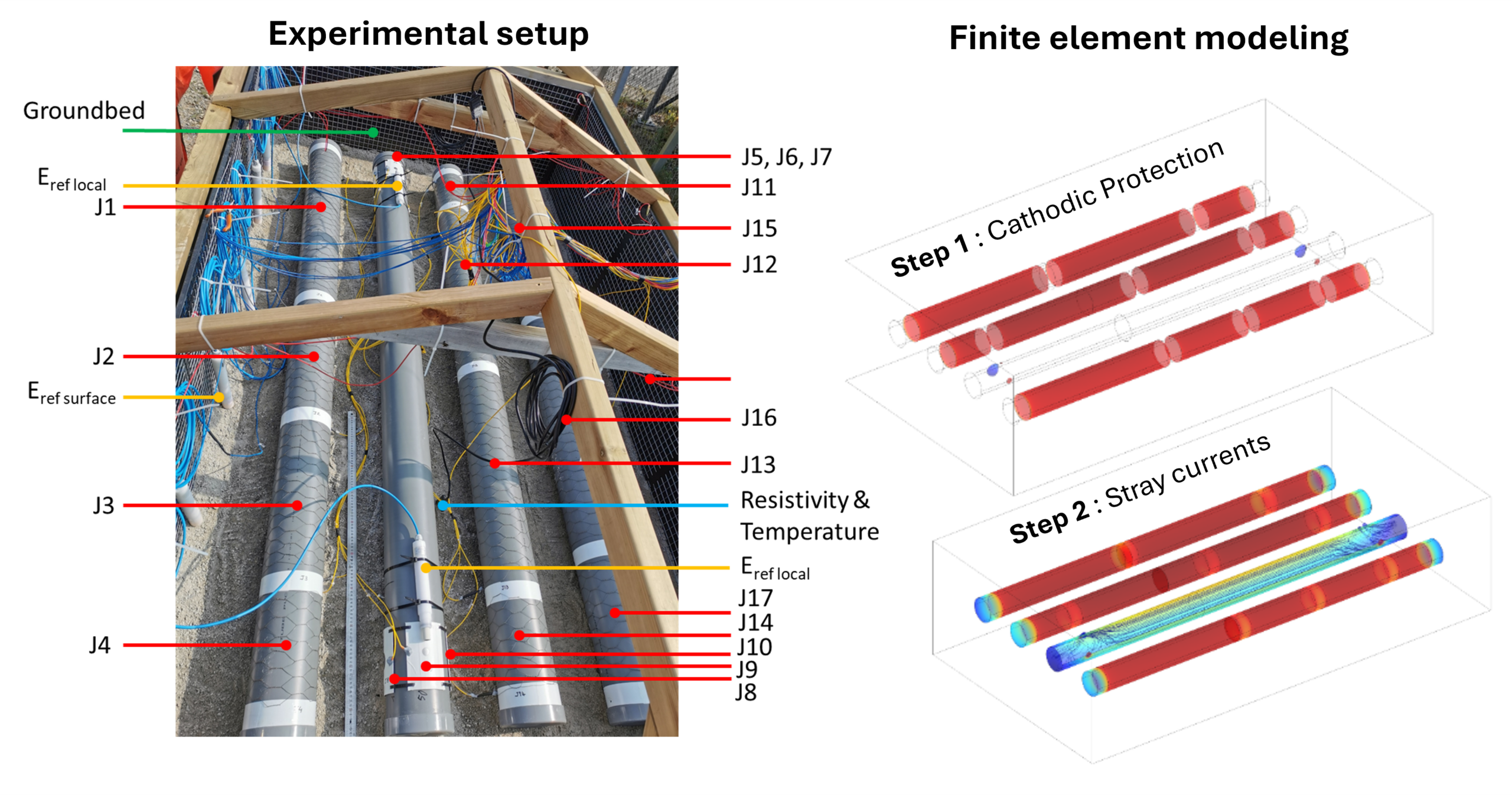
A representative-scale experimental setup was designed and built, consisting of an HDPE tank filled with sand, in which four PVC tubes 160 mm in diameter simulating pipelines were installed in parallel. Seventeen model defects were distributed over the tubes, reproducing two types of active surface: uniformly degraded coating defects (hexagonal metallic mesh) and point defects of variable surface area (circular coupons of 1, 10 and 50 cm²). The setup makes it possible to apply CP on certain pipelines and to measure the stray currents flowing between the defects of an unpolarised pipeline. In parallel, the experimental configuration was reproduced numerically by finite element modelling on COMSOL Multiphysics, using a two-step approach: modelling the CP distribution, then applying the resulting electric field to the structures under influence.
Key results
The study shows that interference phenomena between parallel pipelines generate stray currents and associated corrosion kinetics whose intensity depends strongly on the nature of the defects, the geometric configuration and soil parameters. Point defects are significantly more critical than uniformly degraded coating defects, due to much higher local current densities. Pipelines located between two pipes under CP are more exposed than those on the periphery of the network. The finite element modelling, validated by comparison with experimental measurements, faithfully reproduces the measured currents and confirms the relevance of the two-step approach. This work thus establishes a robust methodology for quantitatively assessing the risk of interference in configurations representative of real industrial sites.