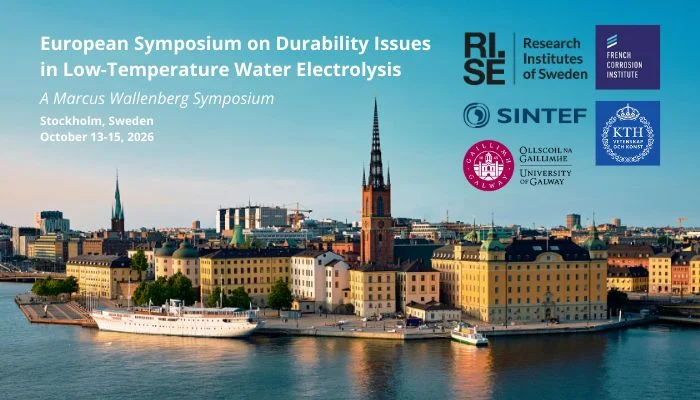
From October 13 to 15, 2026, Stockholm (Sweden) will host the European Symposium on Durability Issues in Low-Temperature Water Electrolysis, organized within the framework of a Marcus Wallenberg Symposium.
This major European scientific event aims to bring together academic stakeholders, research institutes, and industry representatives involved in the field of water electrolysis. It will provide a dedicated forum for discussion on durability challenges, a key issue for the development of hydrogen technologies.
Key topics for the hydrogen of tomorrow
The scientific program will cover a wide range of subjects, including:
- Durability and degradation of components: catalysts, electrolyte membranes, porous transport layers, bipolar plates, and system balance-of-plant components.
- Degradation mechanisms affecting performance: corrosion, hydrogen embrittlement, membrane thinning, catalyst dissolution or coarsening, and contamination of feed water.
- Solutions to improve durability: anticorrosion coatings, surface treatments, and degradation-mitigation strategies.
- Fundamental approaches: electrochemical degradation mechanisms, kinetics, and multiscale modeling.
- Investigation methods: in situ, in operando, and ex situ techniques, as well as accelerated aging testing.
- Innovative materials for next-generation electrolyzers: PFAS-free membranes, non-critical materials, and alternatives to platinum group metals.
- Life cycle and techno-economic analyses: reduction in the use of critical materials and recycling potential.
A collaborative European initiative
This symposium is the result of collaboration between several major European projects dedicated to water electrolysis: SWEETHY, PROTIS, UNICORN, PUSH, and ANEMEL.
The organizers are supported financially by the Marcus Wallenberg Foundation for International Scientific Collaboration, highlighting the strategic importance of this topic at the international level.
Contact: Michel Prestat michel.prestat@institut-corrosion.fr
Link to the scientific programme (update 05-10-2026): SWEETHY Symposium Scientific Programme _v6