
A Horizon Europe Project
Abstract :
CCUS remains a key element in the European strategy for carbon neutrality in 2050, however only pilot projects have been deployed to date. To enable a sustainable CCUS industry at scale, it is vital to ensure a resilient, interoperable, and safe CO2 transport infrastructure capable of handling CO2 streams at different flow rates, pressures and states and with different compositions and impurities.
The presence of impurities in CO2 streams may impact severely thermophysical properties and consequently flow characteristics. Reactive impurities can form strong acids originating unacceptable corrosion of pipelines and ships. These effects combined, may result in unacceptable risks for the infrastructure, the environment, and populations.
IMPACT-EUCO2 will tackle these challenges and bridge the knowledge gaps that hinder the development of an European CO2 transport network.
The project will also work closely with regulators, standardization and certification bodies, technology developers and the industry, and associations to enable the development and rapid market uptake of knowledge based technology, under a common regulatory and standards framework, that ensures interoperability and sustainability, thus contributing for the deployment of CCUS at scale.
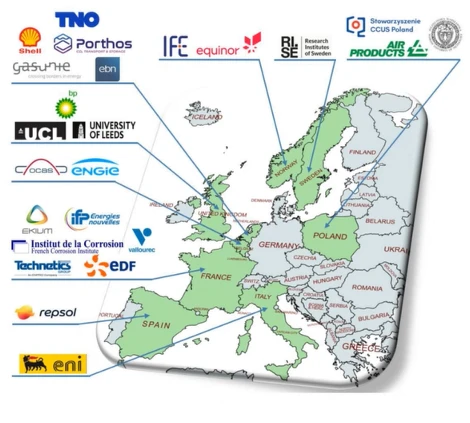
The project is executed by several beneficiaries and supported by a panel of associated industrial partners indicated on the map below.
Beneficiaries of the project :
| Name | Country |
| IFE | Norway |
| University of Leeds | UK |
| University College of London | UK |
| IFPEN | France |
| French Corrosion Institute | France |
| RISE | Sweden |
| TNO | Netherlands |
| Warsaw University of technology | Poland |
| CCUS Poland Association | Poland |
Learn more
To come

This project is funded by the European Union in the frame of the research and innovation program Horizon Europe.
_____________________________________
Views and opinions expressed are those of the author(s) only and do not necessarily reflect those of the European Union or REA. Neither the European Union nor the granting authority can be held responsible for them.