Clad pipelines for safe and efficient hydrogen storage and transport.
The overall objective of the CladPipe4H2 project is the development, manufacturing and testing of new combinations of structural metallic materials for the safe and efficient storage, transport and distribution of hydrogen. Within the project, material combinations will be developed and manufactured, composed of a base material to meet mechanical strength requirements and a cladding material to satisfy hydrogen barrier and embrittlement resistance requirements.
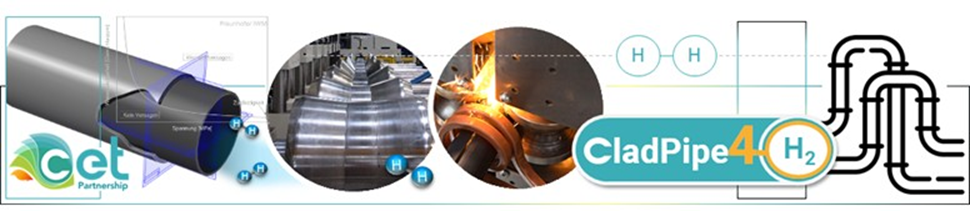
The main objective of the project is to provide durable structural materials and components for stationary (e.g. power generation, machinery, residential and industrial use) and mobile (e.g. road, off-road, rail, maritime and air transport) applications of high-pressure gaseous hydrogen (≥ 300 bar). The priority use cases concern tanks as well as pipelines and piping for the storage and transport of gaseous hydrogen subjected to these high pressures and a large number of load cycles. Thanks to the combination of two metallic materials, savings will be achieved by reducing wall thickness compared with monolithic metallic components and by replacing costly fibre-reinforced polymers. The microstructure and its interactions with hydrogen, as well as their influence on mechanical properties, will be studied. Energy-efficient and cost-effective manufacturing processes for small-series and large-volume production will be implemented, and the manufactured components will be validated using test methods developed for this purpose.
In the CladPipe4H2 project, the French Corrosion Institute leads the testing of materials and components in an H₂ environment. The FCI is developing a test methodology to qualify cladding materials for use in H₂ applications.
Participants
The international, interdisciplinary consortium brings together eight partners from five EU countries and covers the entire value chain, from applied research to industrial application. The aim is to contribute to the safe, economic and sustainable use of hydrogen.
| TU Chemnitz (Germany) | LGF Laboratoire Georges Friedel (France) |
| University of West Bohemia (Czech Republic) | SSAB (Sweden) |
| French Corrosion Institute (France) | Explomet (Poland) |
| RISE Research Institute of Sweden (Sweden) | Czestochowa University of Technology (Poland) |
Results and publications
Coming soon
Learn more
ANR website: https://anr.fr/Project-ANR-24-CETP-0002
Coordinator’s website: https://www.tu-chemnitz.de/mb/UT/projekte_cladpipe.php#Projekt
This project is funded by the European Union under the Horizon Europe research and innovation programme and the Clean Energy Transition Partnership

_____________________________________
The CETP is a multilateral, strategic partnership of national and regional research, development and innovation programmes in European Union Member States and Associated Countries, whose objective is to advance and accelerate the energy transition, and to support the implementation of the European Strategic Energy Technology Plan.
_____________________________________
The views and opinions expressed are those of the author(s) only and do not necessarily reflect those of the European Union or the REA. Neither the European Union nor the granting authority can be held responsible for them.