
Context
In offshore water injection systems, control of dissolved oxygen (DO) content is a common practice to limit the risk of localised corrosion of corrosion-resistant alloys. However, transient DO excursions are unavoidable under operating conditions, and their impact on material integrity remains poorly quantified. In addition, before deaeration, water may be chlorinated to combat biofouling, and residual chlorine may reach well equipment. The combination of these two factors — DO excursions and residual chlorine — represents a potentially critical degradation scenario, in particular for stainless steels and nickel-based alloys used in wells and surface equipment. Defining acceptable DO thresholds, and therefore safe operating windows for material selection and operation, is a major industrial challenge for integrity management of these systems.
Facilities
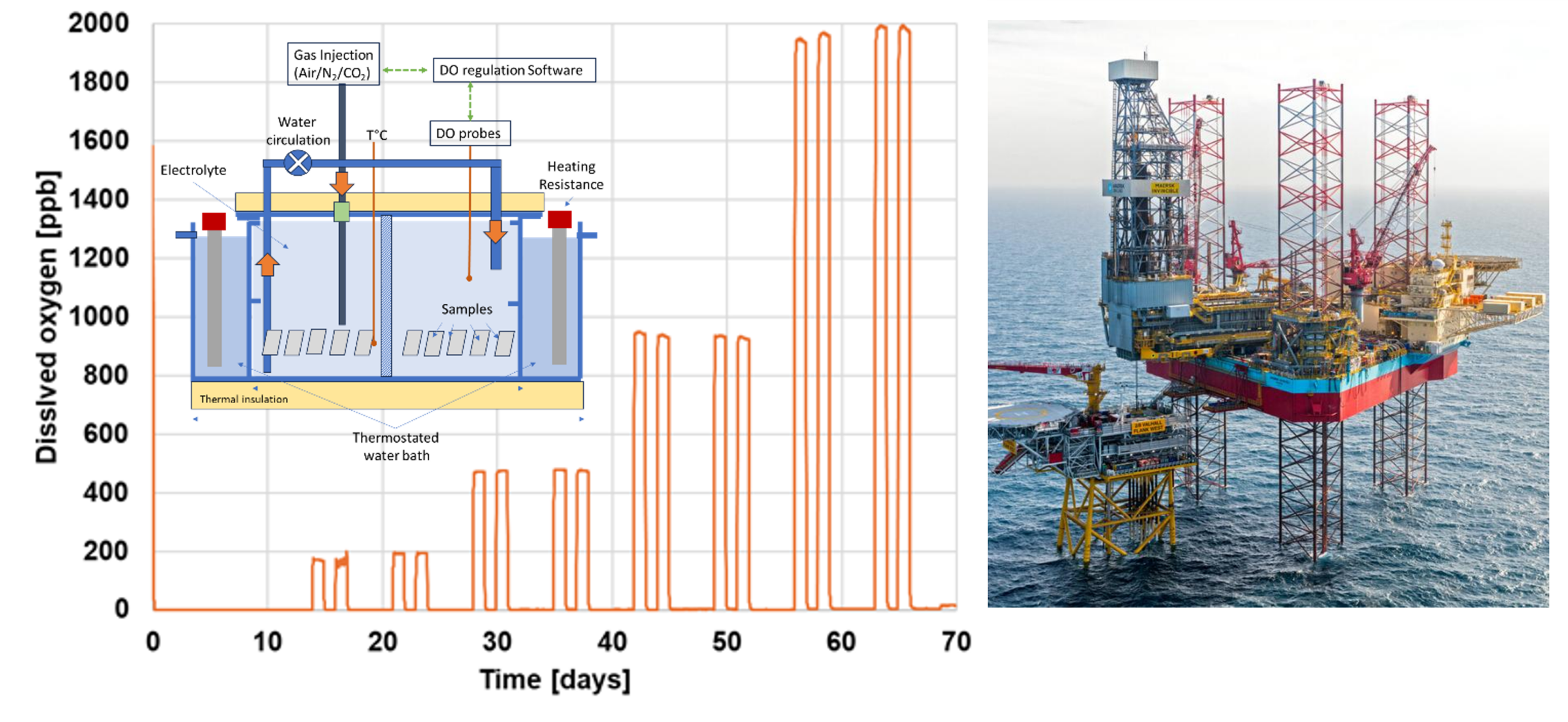
Eight corrosion-resistant alloys were evaluated: S31603 (316L), S32205 (2205), S32750 (2507, with and without thermally sprayed tungsten carbide coating), N07718 (718), N08825 (825), N06625 (625), S42000 (13Cr) and S41425 (S13Cr). The specimens, prepared in accordance with ISO 18070:2015 with PVDF crevice assemblies, were immersed in a sealed 600-litre tank allowing precise control of physico-chemical parameters. Two environments were tested: natural seawater at 20 °C without chlorine (Test 1) and a mixture of production water and monoethylene glycol (MEG) at 40 °C with 0.1 ppm residual chlorine (Test 2). In both cases, after 14 days at 10 ppb DO (normal condition), four successive 24-hour excursions were applied at 200, 500, 1,000 and 2,000 ppb. The free potential of each specimen was monitored continuously. Post-exposure corrosion assessment was performed by optical microscopy and optical interferometry, with measurement of attack depths. The influence of the gasket material (PVDF, graphite 316L, graphite 625, mineral 316L, mineral 625) was specifically studied on the S32205 alloy.
Key results
The study establishes a clear resistance ranking of the alloys tested according to exposure conditions. In seawater at 20 °C without chlorine, high-resistance alloys (N06625, S32750, S32205, N08825, N07718) withstand DO excursions up to 2,000 ppbw, whereas S31603, S41425 and S42000 show increasing susceptibility to crevice corrosion from relatively low excursion levels. In production water at 40 °C with residual chlorine, conditions are significantly more severe: corrosion of S31603 and N08825 initiates even under normal DO conditions, highlighting the dominant role of chlorine as an aggravating factor compared with DO excursions alone. The biofilm-induced ennoblement phenomenon observed in natural seawater progressively amplifies the corrosion risk even outside excursion periods. As for the gaskets, graphite assemblies generate unfavourable galvanic coupling leading to corrosion of the metallic gasket components, whereas PVDF and mineral gaskets have no adverse effect on the S32205.