
Context
In the automotive industry, the pursuit of lightweight and durable structures requires a thorough understanding of the behavior of assemblies, particularly under cyclic loading and in corrosive environments. Spot welds, which are widely used in car bodies (several thousand per vehicle), are especially critical as they concentrate mechanical stresses. In addition, real service environments combine humidity, salts, and temperature variations, which promote corrosion and alter fatigue behavior. However, experimental data that simultaneously account for these effects remain limited, even though they are essential to ensure the long-term reliability of structures.
Methods
A large experimental campaign was conducted on various steels (mild steel, high-strength steels, and quenched steels) with different protective coatings. The assemblies were mainly produced by spot welding, in lap-shear and T-peel configurations, and in some cases complemented by structural adhesive bonding.
The tests included:
- fatigue tests in air used as a reference,
- accelerated corrosion tests (VDA 233-102 standard),
- combined fatigue-corrosion tests, either in sequential mode (successive phases) or in simultaneous mode in dedicated climatic chambers.

Additional analyses were carried out, including metallographic characterizations, crack observations, and measurements of mechanical strength degradation, in order to identify damage mechanisms associated with corrosion and fatigue.
Results and conclusions
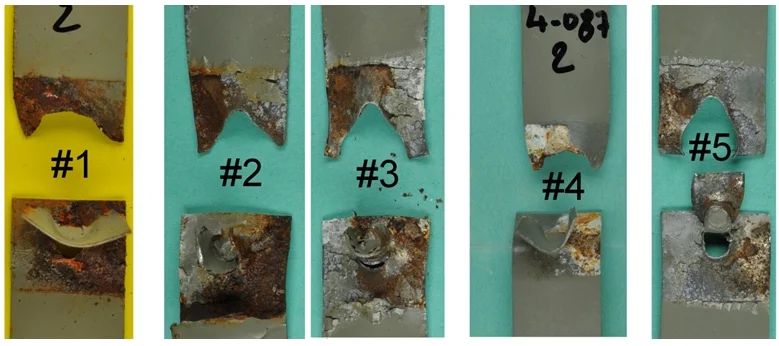
The results highlight a complex interaction between fatigue and corrosion, strongly dependent on loading conditions and assembly geometry. Under combined fatigue-corrosion conditions, a reduction in service life is observed at high load levels, associated with interface opening that facilitates the ingress of corrosive agents. At lower load levels, an opposite effect may occur, attributed to the formation of corrosion products that locally modify stress states or to crack tip blunting.
Spot-welded assemblies generally show relatively good resistance to corrosion effects under cyclic (sequential) conditions, unlike bonded assemblies, which exhibit high sensitivity, particularly due to the degradation of the adhesive/metal interface.
Finally, assembly configuration plays a major role: geometries that promote opening or high stress concentrations (such as T-peel) are more vulnerable. These findings underline the importance of considering both mechanical and environmental effects simultaneously at the design stage to ensure the durability of automotive structures.