
Context
The protection of offshore infrastructure in carbon steel relies on the combination of an organic coating and cathodic protection (CP) provided by sacrificial anodes, designed to last for several decades. At the end of anode life, the structure potential gradually drifts towards the free potential, entering an under-polarisation phase with a non-negligible residual corrosion rate. In the context of reconversion of oil infrastructure to CO₂ or water storage, the question of the acceptability of residual corrosion under low polarisation becomes strategic. Field data at great depth are scarce in the literature, and the specific conditions of cold deep water — low temperature, low flow rate, reduced dissolved oxygen content — are likely to lead to corrosion rates far lower than those predicted by current standards, which are mainly established for surface conditions.
Facilities
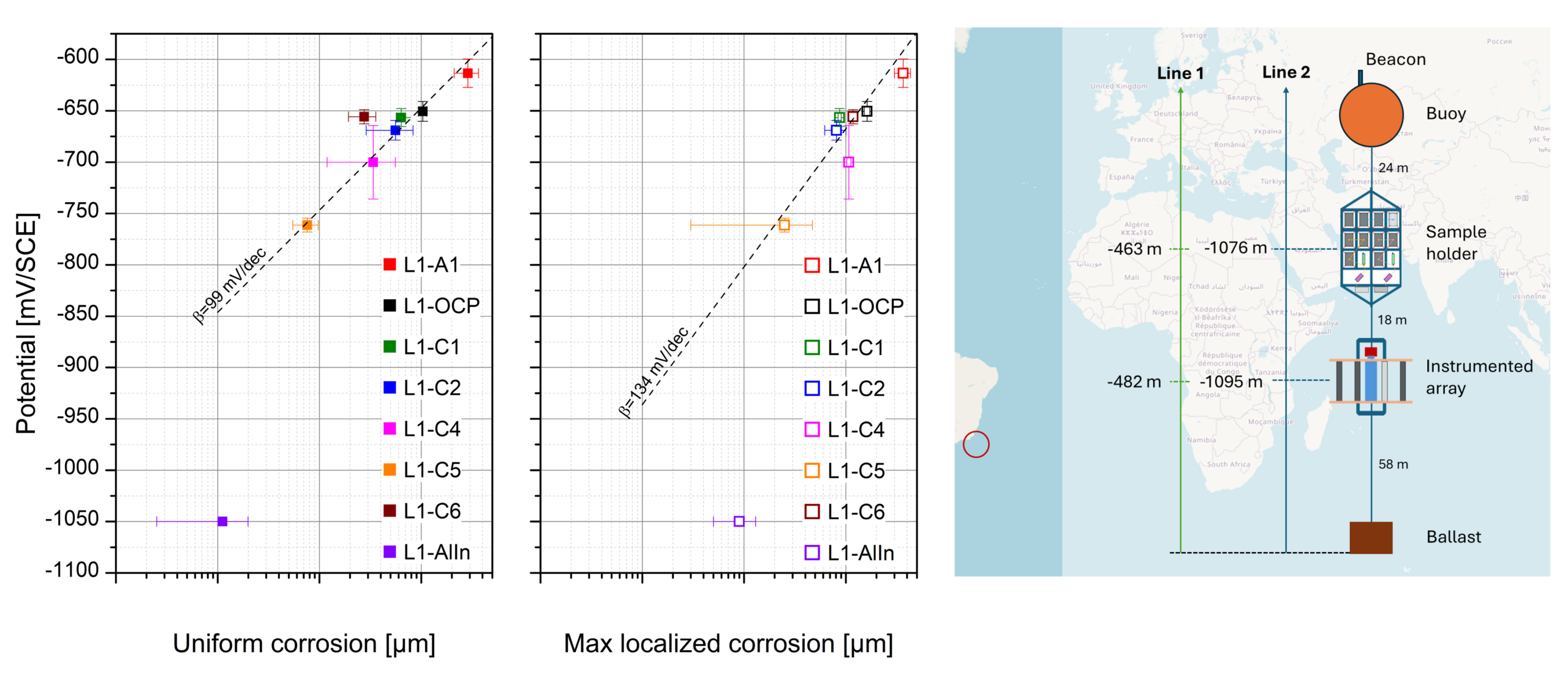
Two identical instrumented mooring lines were immersed for one year in the Campos Basin off Rio de Janeiro (Brazil) at 475 m (Line 1, Namorado field) and 1,085 m (Line 2, Barracuda field) depth, deployed and recovered by remotely operated vehicles (ROVs). Each line carried a sample holder equipped with carbon steel specimens (S235JR and DC01) subjected to various levels of pseudo-potentiostatic polarisation, imposed by combinations of galvanic anodes (AlIn, AlGa), shunt resistors and low-voltage diodes. Autonomous sensors continuously monitored potential, temperature, depth, current velocity, dissolved oxygen, salinity and electroactive biofilm. In parallel, a one-year comparative experiment was carried out in the laboratory in Brest in renewed natural seawater at 3.6 °C, under controlled potentiostatic conditions. Uniform corrosion was assessed by mass loss in accordance with ISO 8407 and localised corrosion by confocal digital optical microscopy.
Key results
The study shows that cathodic protection at low polarisation is effective at significantly reducing corrosion rate under the cold deep-water conditions studied. The uniform corrosion rate clearly decreases with decreasing potential, following a Tafel-type relationship whose slope is lower in cold deep water than in surface conditions, indicating that moderate polarisation is sufficient to achieve significant protection. The corrosion rates measured at OCP in the field are consistent with previous data obtained in the North Atlantic, but significantly higher than those obtained in the laboratory, highlighting the difficulties of faithfully reproducing field conditions. The experimental protection potentials determined from corrosion rate criteria (10 and 25.4 µm/year) turn out to be globally more electropositive than the value recommended by ISO 15589-2, suggesting that the standardised criterion is conservative for these environments. These results pave the way for a reassessment of protection strategies in cold deep waters, in particular for structures at the end of anode life.