Context
Hydrogen absorption in steels is a major issue for the automotive industry, where advanced high-strength steels (AHSS) are widely used. This hydrogen can be generated during corrosion processes, particularly in the presence of salts and moisture, and may lead to embrittlement phenomena capable of causing premature material failure.
Conventional methods, such as electrochemical permeation, offer excellent sensitivity but suffer from a lack of spatial resolution, making it difficult to detect locally critical areas. Conversely, local techniques such as the Scanning Kelvin Probe (SKP) enable mapping of hydrogen distribution, but their quantification remains challenging.
In this context, the development of new approaches combining multiple techniques is essential to achieve a detailed understanding of hydrogen ingress, diffusion, and accumulation mechanisms in steels.
Methods
The work is based on a multi-technique approach combining electrochemical, microscopy, and surface analysis methods.
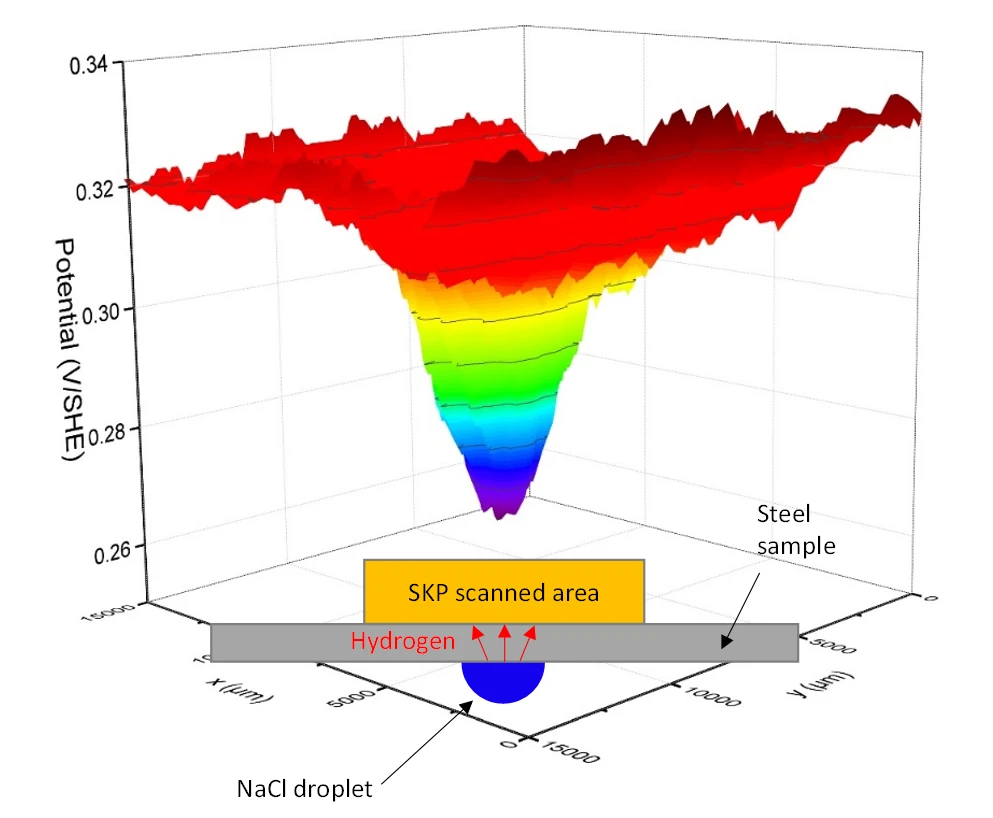
The SKP technique is used to locally measure potential variations related to the presence of hydrogen, which influences the composition of the oxide film by reducing ferric species Fe(III) to Fe(II). This method enables spatial mapping of hydrogen at the micrometer scale.
To overcome the lack of quantification inherent to SKP, a calibration with the electrochemical permeation technique (EPT) has been developed, allowing the measured signal to be correlated with the subsurface hydrogen concentration.
In addition, XPS spectroscopy is used to characterize the chemical evolution of the oxide film, particularly the Fe(II)/Fe(III) ratio, in relation to hydrogen activity.
Finally, an innovative approach based on reflection optical microscopy combined with machine learning algorithms has been proposed to detect hydrogen permeation through subtle optical variations, thereby improving the sensitivity of local analysis.
Results and conclusions
The work demonstrated that hydrogen can be locally detected and mapped in steels by exploiting its interaction with the surface oxide film. The combination of SKP and electrochemical permeation techniques enables more reliable quantification of hydrogen while maintaining relevant spatial resolution.
The results also confirm that the measured potential variations are closely related to changes in the oxide film, particularly the Fe(II)/Fe(III) ratio, although other phenomena (reoxidation, material condition) may also influence the signal.
Furthermore, the optical approach coupled with machine learning proved capable of detecting very weak signals, opening the way to more accessible methods for monitoring hydrogen permeation.
Overall, this work highlights the importance of a multi-technique approach for characterizing hydrogen in steels and underscores the key role of local hydrogen distribution in assessing embrittlement risks.