
Context
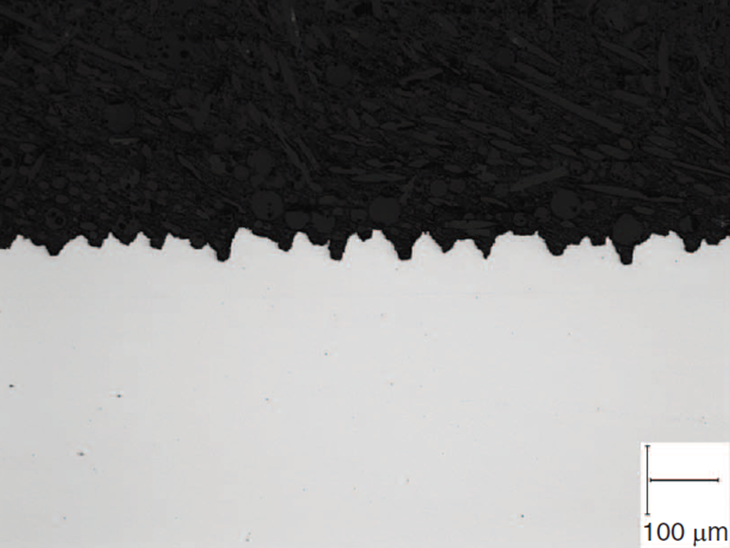
The resistance of carbon steels to environments containing hydrogen sulfide (H₂S) is generally assessed through standardized tests designed to detect sulfide stress cracking (SSC). However, these tests often reveal the presence of surface micro-grooves, even in the absence of confirmed cracking. This situation complicates the interpretation of results and material qualification, as there is no clear consensus on whether these features should be considered acceptable or critical. Some guidelines even regard depths comparable to those of cracks as potentially critical, without clearly distinguishing their nature.
In this context, it is essential to better understand the formation of these micro-grooves and their actual relationship to cracking mechanisms.
Methods
The study was conducted on two steels representative of the oil and gas sector (C110 and X65), subjected to SSC tests in various H₂S-containing environments. Several mechanical loading configurations were employed (uniaxial tension and four-point bending), with different stress levels and exposure durations of up to one month. Chemical conditions (pH, solution composition) were also adjusted to assess their influence on micro-groove formation.
The experimental observations were complemented by metallographic analyses and image processing to characterize defect morphology. In parallel, finite element modeling was used to evaluate stress and strain fields in the vicinity of the micro-grooves, taking into account their geometry and distribution. This combined approach made it possible to establish correlations between test conditions, micro-groove formation, and crack initiation potential.
Results and conclusions
The results clearly show that the observed micro-grooves do not correspond to a SSC mechanism, but rather to a stress-assisted corrosion phenomenon that strongly depends on the environment and the level of applied load. Their formation can occur even under conditions where the material is known to be resistant to cracking.
However, these micro-grooves play an important indirect role: they locally concentrate mechanical stresses and can thus promote crack initiation when critical conditions are reached, particularly in the presence of high localized plastic deformation.
The study also highlights that the growth rate of micro-grooves is significantly slower than that of SSC cracks. Therefore, if a material is truly susceptible to cracking, it should still be observable despite the presence of micro-grooves. Finally, although some classification approaches consider these micro-grooves acceptable, it is demonstrated that they may still act as crack initiation sites under certain conditions.