
Context
The exploration and exploitation of the deep seabed represent a growing challenge for many industries, requiring the use of reliable, corrosion-resistant materials under deep seawater conditions. While the behaviour of stainless steels and passive alloys in surface water is well documented, data on deep environments remain very limited in the literature. Yet several parameters specific to these environments — such as temperature, dissolved oxygen content, hydrostatic pressure and biological activity — are likely to significantly influence localised corrosion mechanisms (pitting and crevice). In particular, the formation of electroactive biofilms, responsible for ennoblement of the potential of passive alloys and an increased risk of corrosion, had never been documented in deep water. As results obtained in the laboratory or in surface water cannot be directly extrapolated to great depths, it became necessary to conduct instrumented in situ exposures in real environments.
Facilities
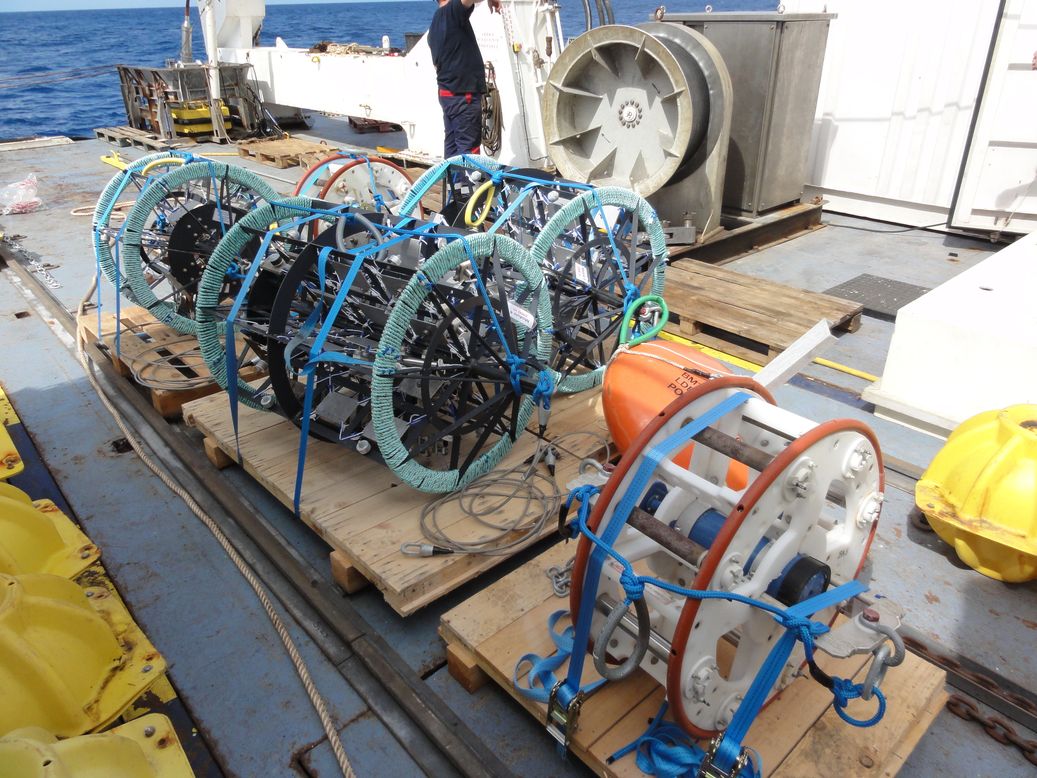
The study was based on the deployment of an instrumented anchored line for 11 months in the Atlantic Ocean (Azores region), at two representative depths: an intermediate depth (1,020 m) and an abyssal depth (2,020 m). A wide range of materials was evaluated, including ferritic, austenitic, lean duplex, duplex, super duplex, hyper duplex and super austenitic stainless steels as well as nickel-based alloys, together with a reference carbon steel. Crevice corrosion resistance was assessed using PVDF standardised assemblies in accordance with ISO 18070:2015, tested at two different gasket pressures, on plate and tube geometries. Continuous monitoring of the open-circuit potential (OCP) enabled in situ characterisation of the formation and activity of electroactive biofilms. The environment was characterised continuously using sensors measuring temperature, current velocity, dissolved oxygen and salinity. Quantification of corrosion was carried out by mass loss, measurement of attack depths by optical microscopy, and visual analysis after descaling.
Results
The results show that the corrosion rate of carbon steel in deep water is comparable to that measured in surface water, with no significant aggravating effect related to depth. Low-alloyed ferritic stainless steels proved to be very highly susceptible to pitting and crevice corrosion, regardless of exposure depth. Conversely, high-grade stainless steels (super duplex, hyper duplex, super austenitic) showed no localised corrosion under the conditions tested. A corrosion resistance ranking could be established for austenitic, lean duplex and duplex steels. Regarding biological activity, ennoblement of the potential linked to the formation of an electroactive biofilm was observed at both depths, but with a significantly longer onset in deep water than in intermediate water, reflecting the influence of temperature on microbial development. These results suggest that corrosion data obtained in cold surface water constitute a good conservative approximation of the corrosion risk in deep seawater.