Context
Andra is responsible for the Cigéo (Industrial Centre for Geological Disposal) project for the deep geological disposal of high-level (HLW) and intermediate-level long-lived (IL-LLW) radioactive waste in the Callovo-Oxfordian clay formation located at a depth of 500 m. The disposal concept is based on a multi-barrier system, including carbon steel liners inserted into microtunnels to host vitrified nuclear waste containers. During the operational phase, the liners and waste packages are exposed to evolving environmental conditions, ranging from humid, aerated atmospheres to water-saturated and deaerated conditions, while being subjected to ionizing radiation emitted by the waste. Gamma-induced radiolysis of air and water may lead to the formation of oxidizing and acidic species that can influence the corrosion behavior of carbon steel. In this context, both the Andra and the French Corrosion Institute have developed new electrical resistance (ER)-based corrosion sensors specifically designed for deep geological disposal environments. This study presents part of the qualification results of these ER sensors under gamma irradiation, as well as real-time measurements of the corrosion rate of carbon steel under irradiation.
Methods
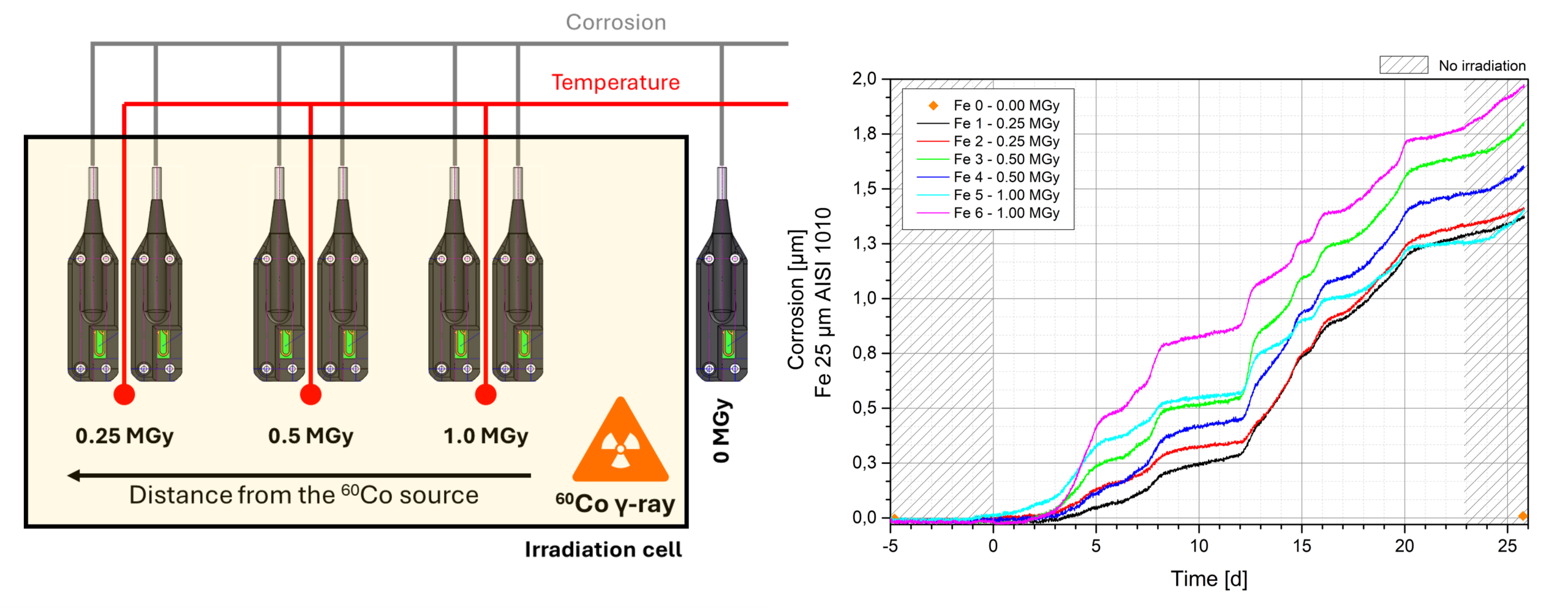
Seven ER sensors consisting of 25 µm thick AISI 1010 steel tracks were used in this study. Six of them were installed in an irradiation cell (ASNR Paris-Saclay) at different distances from a Cobalt-60 source in order to be subjected to three distinct irradiation dose levels (0.25, 0.50, and 1.00 MGy). The sensors were successively exposed to a phase without irradiation, followed by a phase under irradiation for several weeks, and finally returned to a phase without irradiation. A seventh sensor, positioned outside the cell, was used as a non-irradiated reference. Temperature and relative humidity were continuously monitored inside the cell. The transmitters and the data logger, located outside the irradiation chamber, continuously measured the electrical resistance of the ER sensors, thereby enabling real-time calculation of corrosion depth and corrosion rate.
Main results
Electrical resistance (ER) corrosion sensors developed within the framework of the Cigéo project, dedicated to the deep geological storage of high-level radioactive waste, were qualified under irradiation conditions. The ER sensors used in this study, made of AISI 1010 carbon steel in the form of thin tracks (25 µm), were exposed to atmospheric conditions under three distinct radiation dose levels (0.25, 0.50, and 1.00 MGy) using a Cobalt-60 gamma source. The results show that the developed ER sensors remain reliable even under highly ionizing conditions, without significant degradation of their measurement performance. Although relatively low relative humidity levels, ranging from 45% to 60%, were recorded, the data provided by the ER sensors indicate that the conditions generated under irradiation induce corrosion of AISI 1010 carbon steel, highlighting a potential dose effect on the corrosion rate of the steel.