Under service conditions, offshore structures are subjected to fatigue loading. This can affect the durability and safety of components made from super duplex stainless steels (SDSS). In particular, the use of a cathodic protection (CP) system can induce hydrogen charging in SDSS. Such charging can potentially lead to phenomenon of hydrogen embrittlement under fatigue. The objective of this work was therefore to investigate the sensitivity of SDSS 2507 (UNS S32750) umbilical tubes, both welded and unwelded, under test conditions as close as possible to real service environments.
Alternating four‑point bending fatigue tests were carried out in natural seawater, with and without cathodic protection. Fatigue behavior was evaluated as a function of environmental parameters such as temperature. Material parameters were considered as well, particularly
- grain size,
- inter‑austenite spacing,
- microstructure around orbital TIG welds,
- the presence of surface defects, such as mechanical notches, inducing stress concentrations.
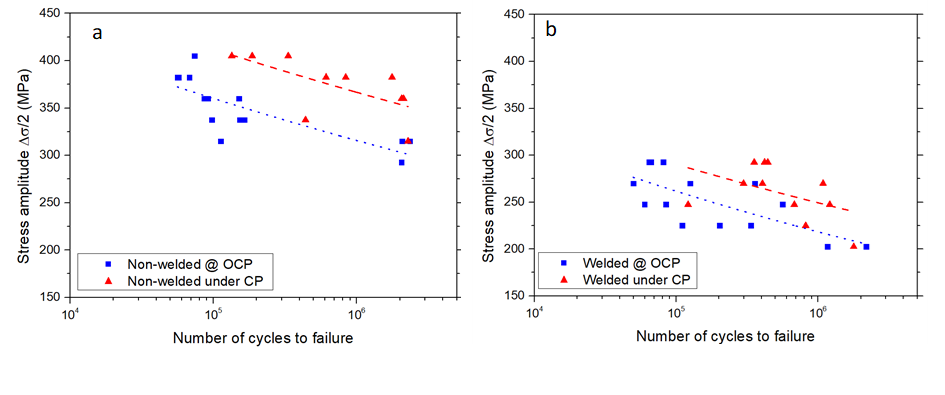
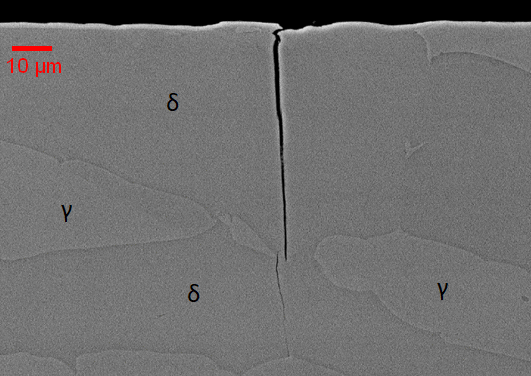
The fatigue peformance obtained in air or in seawater at the open circuit potential were found to be quite similar. This was attributed to the absence of localized corrosion under these test conditions. Then, an improvement in fatigue life was systematically observed under cathodic protection, especially at low applied load levels, despite the presence of brittle fracture features on the fracture surfaces of specimens tested under CP.
The results suggest that SDSS is immune to phenoemnon of hydrogen embrittlement under fatigue for the conditions considered in this study.