
Context
In offshore and subsea environments, cathodic protection is widely used to mitigate the corrosion of metallic structures. However, this protection promotes hydrogen uptake by materials, which may lead to stress cracking phenomena, particularly at the threads of bolted assemblies. Increasing mechanical performance requirements are driving the use of high-strength alloys, especially nickel-based alloys, whose susceptibility to HISC (Hydrogen Induced Stress Cracking) must be rigorously assessed. Despite numerous studies, uncertainties remain regarding the fundamental cracking mechanisms and the ranking of materials according to their resistance under actual service conditions.
Methods
The work combines several experimental approaches to reproduce the severe conditions encountered in service. Mechanical tests under incremental loading and constant load were performed on notched specimens or threaded studs to simulate the stress concentrations present in bolted assemblies.
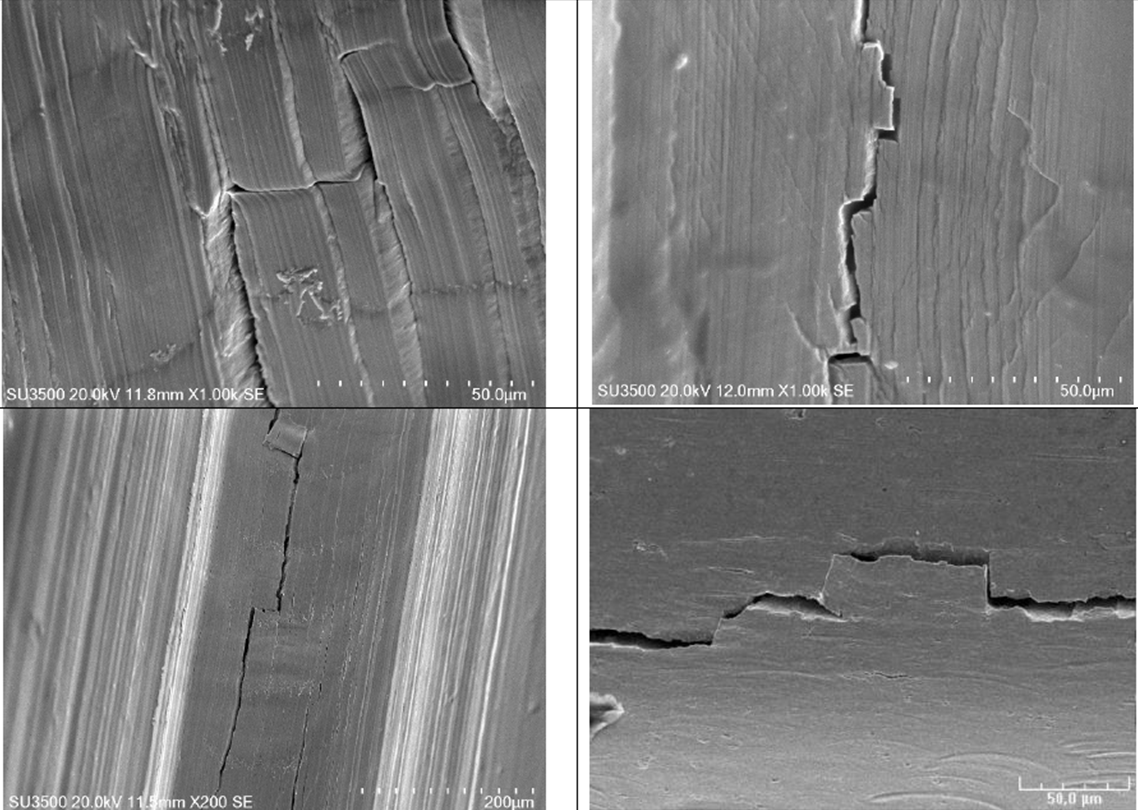
Monitoring of crack initiation and propagation was carried out using acoustic emission and electrical monitoring techniques, enabling early detection of cracking phenomena. In addition, advanced fractographic analyses, particularly statistical fractography, were used to link fracture morphologies to local mechanical properties, especially fracture toughness in the presence of hydrogen.
Microstructural characterizations (electron microscopy, hardness mapping) were also conducted to investigate the influence of microstructure and manufacturing processes—such as cold working or thread rolling—on susceptibility to cracking.
Results and conclusions
The results highlight significant differences in behavior between the alloy families studied. Certain nickel-based alloys, as well as some austenitic steels, exhibit excellent resistance to HISC, even at high mechanical strength, whereas other alloys prove to be more susceptible and must be ruled out for certain applications.
The work also confirms that microstructure plays a determining role in cracking mechanisms, notably through the presence of precipitates or the effect of cold working on hydrogen mobility. Furthermore, crack initiation occurs preferentially in areas of high localized deformation, while propagation follows mechanisms governed by the coupling between plasticity and hydrogen diffusion.
Finally, the combined experimental approaches, including acoustic emission and statistical fractography, appear particularly relevant for refining the determination of critical thresholds and improving the understanding of cracking mechanisms. These results contribute to better material selection and enhanced reliability of subsea assemblies.