Context
The development of incineration processes for nuclear waste containing chlorinated compounds leads to the formation of deposits rich in metal chlorides, particularly ZnCl₂, on equipment.
These deposits can become hygroscopic and form liquid films through deliquescence, even at low relative humidity, making so-called “wet” corrosion possible under conditions that would otherwise be considered dry.
This phenomenon is analogous to the so-called “cold-end” corrosion observed in industrial incinerators, where the presence of salts (chlorides, sulfates, ashes) and aggressive gases promotes accelerated material degradation.
Despite industrial feedback, corrosion mechanisms—particularly in welded areas subjected to microstructural heterogeneities and mechanical stresses—remain insufficiently understood.
Methods
The study is based on an experimental program combining accelerated corrosion tests and multi-scale characterizations.
Cyclic tests were conducted in a climatic chamber with controlled ZnCl₂ contamination, simulating the formation of deliquescent liquid films at elevated temperature (~95 °C) and moderate relative humidity (~30%).
Three main materials were evaluated: AISI 316L, UR66™ and Hastelloy® C22, under different configurations (welded specimens, four-point bending, U-bend) in order to study the effect of mechanical stresses.
The influence of welding processes and filler metals was analyzed, particularly for C22 with several Mo- and W-enriched wires.
The analyses combined visual observations, metallography, pitting measurements, non-destructive testing (radiography, dye penetrant testing), as well as advanced techniques such as Scanning Kelvin Probe (SKP) to map local electrochemical potentials and better understand galvanic corrosion phenomena within welds.
Results and conclusions
The results show a strong dependence of corrosion behavior on both the material and its metallurgical condition.
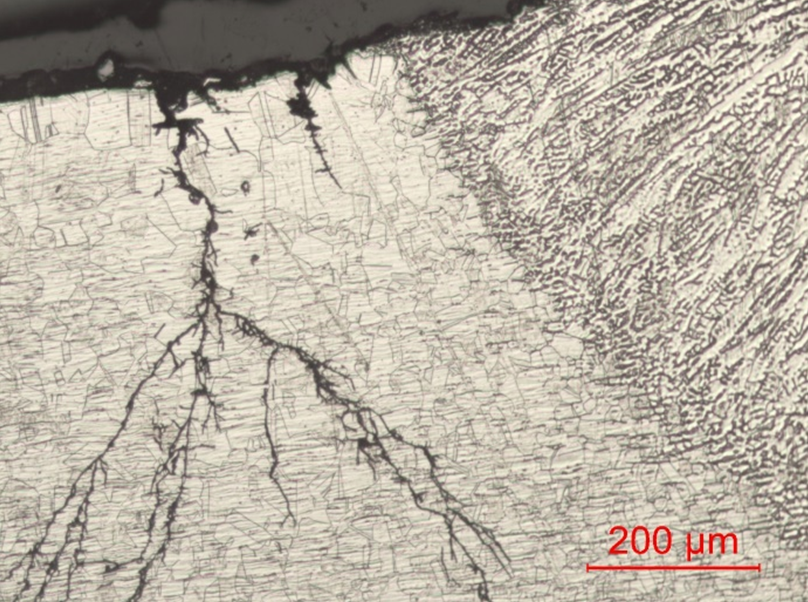
AISI 316L stainless steel, although relatively resistant to localized corrosion in the absence of stress, proves to be highly susceptible to stress corrosion cracking in the presence of zinc chlorides, which limits its use in such environments.
The UR66™ alloy exhibits better resistance to cracking but remains susceptible to pitting corrosion, mainly in the heat-affected zone (HAZ), in connection with local microstructural and galvanic effects.
The nickel-based alloy Hastelloy® C22 shows the best overall performance, with high stability against cracking and localized corrosion largely confined to the fusion zone.
The study also highlights the decisive role of:
- the composition of filler metals (particularly Mo and W contents),
- the microstructure (dendrite size, interdendritic regions),
- and welding processes (pulsed mode, surface treatments).
Finally, the results confirm that electrochemical heterogeneities in welds (mapped by SKP) govern the initiation of localized corrosion through galvanic coupling effects, and that controlling these parameters is essential to improve equipment durability.