Context
The protection of buried pipelines and onshore structures relies on the combination of an organic coating and cathodic protection (CP). Current standards, in particular ISO 15589-1, set a limit potential of -1,200 mV/CuCuSO₄ beyond which the structure is considered to be in over-polarisation, with the risk of damaging the coating by cathodic disbondment (CD). Yet, under field conditions, more negative potentials can be reached locally due to soil heterogeneities, coating ageing or seasonal variations. CD is a complex phenomenon, conditioned by the nature of the coating, the chemistry of the electrolyte, the temperature and the electrochemical processes at play. While CD is abundantly documented in aqueous media, its specific behaviour in soil — where moisture level, pH buffer capacity and oxygen diffusion differ considerably from seawater — had not previously been studied in the literature.
Facilities
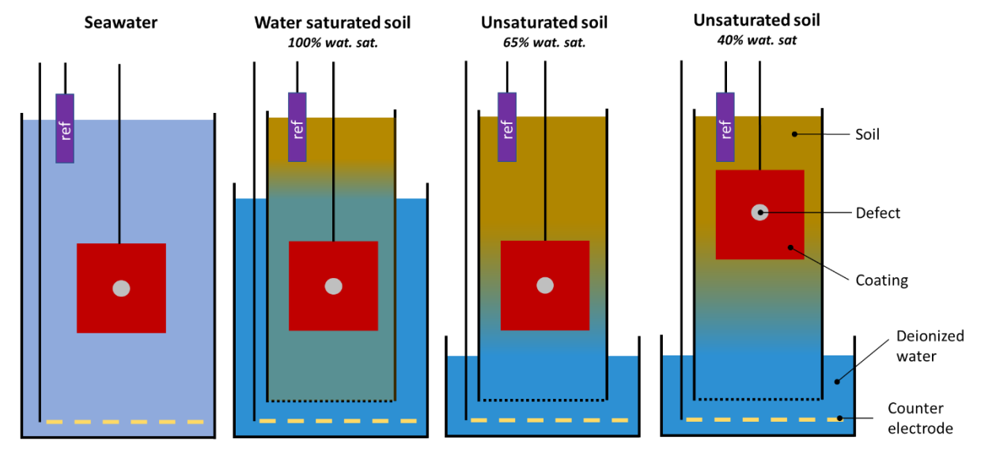
Specimens coated with fusion bonded epoxy (FBE) and three-layer coating (3LPE) were exposed in three distinct environments: natural seawater (Brest Bay), artificial sandy loam soil to ISO 11268, and quarry backfill sand. In soils, three moisture levels were controlled by capillarity (40, 65 and 100% water saturation). Tests were conducted at various imposed potentials (from OCP to -1,400 mV/CuCuSO₄) and for durations ranging from 28 days to 12 months. The cathodic currents received by each specimen were continuously measured via shunt resistors. Cathodic disbondment was assessed after exposure in accordance with ISO 20340 and ASTM G8, by measuring the maximum radial disbondment length around the initial 10 mm diameter defect.
Key results
The study reveals that soil moisture level is a decisive factor in cathodic disbondment kinetics, independently of the applied potential. Under cathodic protection, cathodic disbondment is greater in saturated soils and in seawater, despite higher current densities in water-unsaturated soils. This counter-intuitive result suggests that oxygen transport under unsaturated conditions plays a protective role by limiting the dissolution of the oxide layer at the metal/coating interface. The FBE and 3LPE coatings show comparable behaviour, although dispersion is more pronounced for 3LPE. The kinetics of cathodic disbondment in seawater follow a Fickian law, with dispersion increasing with exposure time. These results confirm that cathodic disbondment tests in seawater constitute a conservative and relevant approach, including for buried soil applications.