
Context
As part of the Cigeo project led by the French National Radioactive Waste Management Agency (Andra), a deep geological storage facility is under development to host high-level (HL) and intermediate-level long-lived (ILW-LL) radioactive waste. This storage will be built in a Callovo-Oxfordian claystone (Cox) layer, at 500 metres depth, which has been studied since 1999 at the Meuse/Haute-Marne underground laboratory. The concept chosen for HL waste is based on the insertion of a carbon steel (CS) liner into micro-tunnels excavated in the rock, intended to hold the vitrified waste canisters. This liner will be in contact with various evolving environments, in particular the host rock and an annular filling material (MREA) injected to limit corrosion. In this context, the aim of this study is to assess the corrosion of carbon steel and microbial development under conditions representative of the storage, as well as their potential interactions, in particular the phenomenon of microbially influenced corrosion (MIC).
Facilities
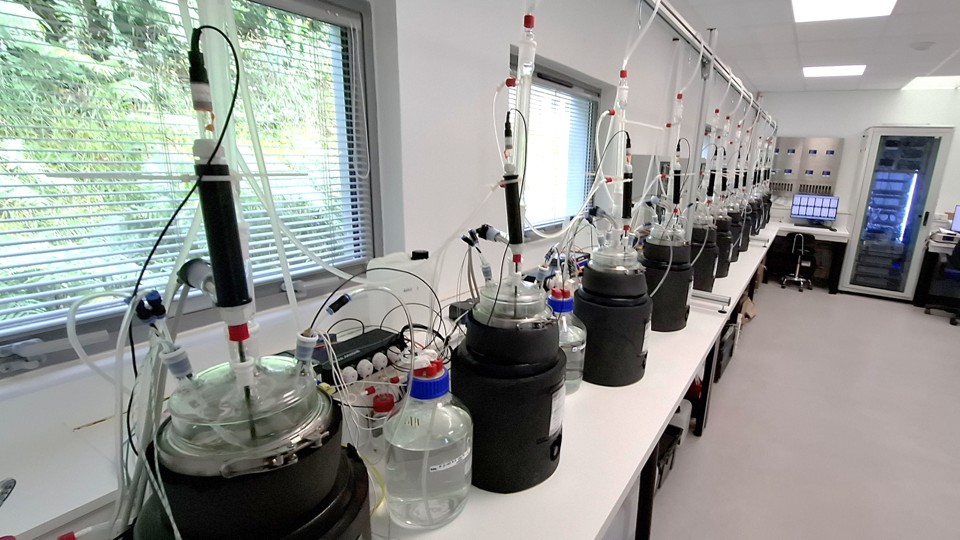
To meet these objectives, a multi-scale experimental approach was implemented, based on three main methodological lines. First, microorganisms typically implicated in MIC phenomena were selected and collected, on the one hand from international collections of bacterial strains, and on the other hand by enrichment from samples taken directly from the underground laboratory, in order to obtain microbial populations suited to this specific environment. Secondly, long-term experiments were carried out under anaerobic conditions and in media representative of the storage, varying temperature (30, 50 and 80 °C), MREA formulation and the presence or absence of microorganisms. Finally, rigorous monitoring of the experimental conditions was ensured through the control of key parameters such as temperature, dissolved oxygen, corrosion potential and redox potential, as well as the controlled addition of nutrients and microorganisms. Corrosion characterisation was carried out using coupons and real-time corrosion sensors, supplemented by in-depth microbiological analyses including culture-based approaches and molecular characterisations.